A complete vegan catering menu for 20–50 guests follows this blueprint: open with two or three finger appetizers, serve one filling main (a grain bowl, taco bar, or stuffed squash), add two hearty sides, a starch, and a dessert, then label every dish for allergens. For a buffet, plan 400–500 g of food per person; for a cocktail reception, count 8–12 bite-sized pieces per guest. A plated dinner needs a starter, a 200–250 g main portion, and a single dessert.
Every plant-based catering menu should include:
- Dips and spreads (hummus, baba ganoush, white bean dip) to anchor the appetizer table
- Cold appetizers (stuffed grape leaves, bruschetta, vegetable rolls)
- Warm appetizers (samosas, spring rolls, stuffed mushrooms)
- One filling main (lentil shepherd’s pie, black bean taco bar, chickpea curry)
- Two hearty sides (roasted root vegetables, grain salad)
- A starch (rice, flatbread, roasted potatoes)
- Dessert (sheet cake, date bars, coconut mousse cups)
- Drinks (sparkling water, a mocktail, one signature cocktail option)
- Allergen labels on every dish, displayed at the buffet or printed on the plated menu
Pro Tip: If you want a turnkey solution rather than building from scratch, Burritosplendido’s vegan catering handles the menu design, portioning, and on-site logistics for events across Winnipeg and Manitoba.
Key takeaways
A successful vegan catering menu anchors every course around one filling main, balances textures across hot and cold dishes, and labels every item clearly for allergens.
| Point | Details |
|---|---|
| Plan 400–500 g per person for buffets | This range covers a multi-dish spread; scale up 15% for groups under 20. |
| Lead with one filling main | Guests need a protein-forward anchor dish; sides and apps alone leave people hungry. |
| Label every dish for allergens | Vegan menus can still contain gluten, nuts, sesame, and soy; clear labels protect guests. |
| Build-your-own formats reduce waste | Taco bars and grain bowl stations let guests self-serve, cutting over-portioning and cross-contact risk. |
| Burritosplendido handles it for you | Their from-scratch, Manitoba-sourced vegan catering covers portioning, allergens, and on-site logistics. |
Table of Contents
- What should a vegan catering menu include by course?
- How much food do you need per person?
- Three ready-to-copy sample menus for your event
- Make-ahead and on-the-day logistics for vegan catering
- How do you handle allergens and labelling at a vegan event?
- Which desserts and drinks travel and hold well for events?
- What pantry staples do you need for vegan catering in Canada?
- How does a professional caterer build a vegan menu?
- Common challenges in vegan catering and how to solve them
- What the data actually tells you about vegan event menus
- Burritosplendido makes vegan event catering straightforward
- Sources
What should a vegan catering menu include by course?
A well-built plant-based menu earns its keep by covering every hunger level in the room, from the guest who nibbles to the one who arrives starving. Instacart’s party food guide puts it plainly: include at least one genuinely filling option, or guests leave disappointed regardless of how many small plates you’ve laid out.
Appetizers (finger and warm)
- Hummus and pita with crudités
- Guacamole with tortilla chips
- Mini samosas or spring rolls
- Bruschetta with roasted tomato and basil
Finger apps are the easiest make-ahead items on the table. Warm apps like samosas reheat in 10 minutes and hold well in a chafing dish, which makes them reliable for large groups.
Mains
- Black bean and roasted pepper taco bar
- Chickpea tikka masala with basmati rice
- Lentil and vegetable shepherd’s pie
- Stuffed acorn squash with wild rice and cranberries
One filling main is the anchor. Two is better for groups over 40, especially when the crowd is mixed and some guests are eating vegan for the first time.
Sides and starches
- Roasted root vegetables (carrots, parsnips, beets)
- Sesame noodle salad or a squash and barley salad
- Garlic herb roasted potatoes
- Steamed jasmine rice or flatbread
Desserts and drinks are covered in their own section below.
Pro Tip: Pair at least one cold dish with every warm dish. A chilled sesame noodle salad next to a warm chickpea curry gives guests textural contrast and keeps the buffet table from feeling heavy.
How much food do you need per person?
These rules of thumb keep you on the right side of both.
| Event format | Food per person | Notes |
|---|---|---|
| Cocktail reception | 8–12 bite-sized pieces | Increase if no dinner follows |
| Buffet dinner | 400–500 g total | Across all dishes combined |
| Plated dinner (starter) | 80–100 g | Soup or salad |
| Plated dinner (main) | 200–250 g | Protein + starch + vegetable |
| Plated dinner (dessert) | 80–100 g | Single portion |
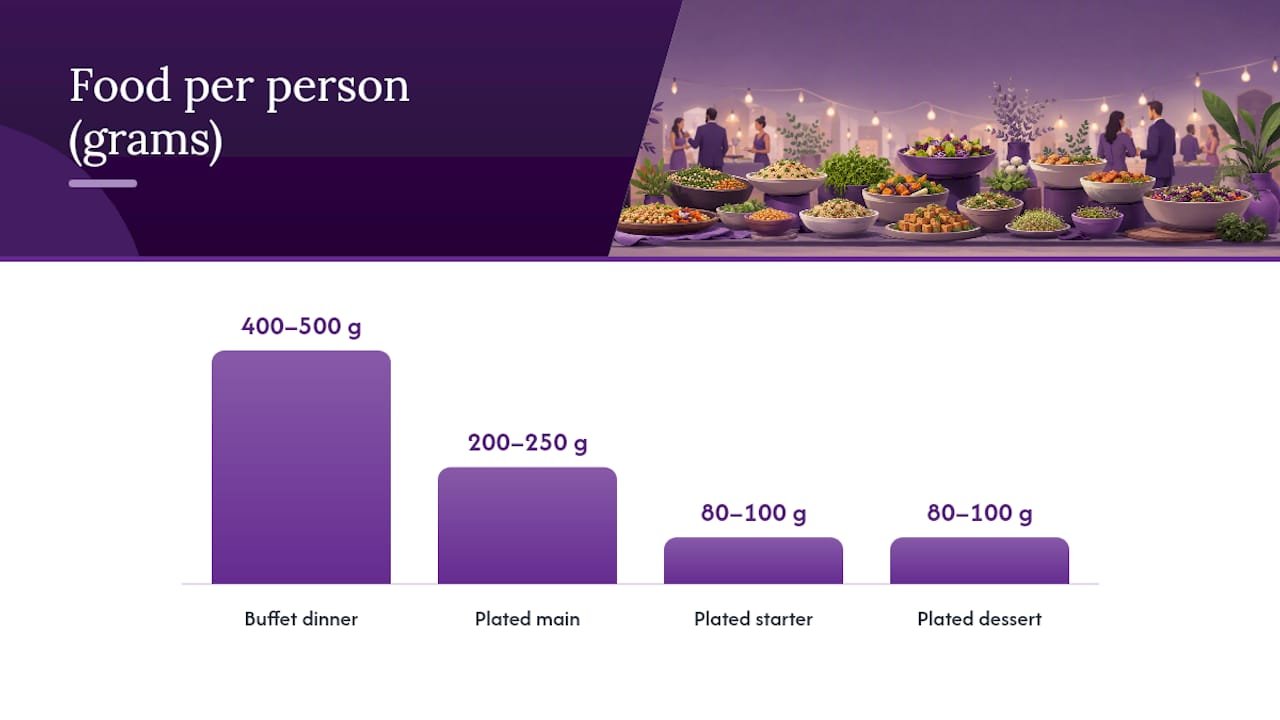
For a multi-dish buffet, 400–500 g per person is the practical floor. Err slightly high on starches and dips; they’re cheap, filling, and almost never wasted.
A few scaling notes worth keeping:
- For groups under 20, add 15% to every quantity. Small groups eat unpredictably.
- For groups over 60, you can trim the per-person estimate by about 10% because variety reduces individual consumption.
- Leftovers from grain salads and roasted vegetables keep well for 3 days refrigerated. Avocado-based dishes do not; prepare those day-of.
Three ready-to-copy sample menus for your event
These three menus cover the most common event formats. Each is designed to be handed directly to a caterer or used as a shopping template.
1. Cocktail reception (30 guests)
- Hummus trio (classic, roasted red pepper, black bean) with pita and crudités
- Guacamole with house-made tortilla chips
- Mini vegetable samosas (3 per person)
- Bruschetta on toasted baguette with roasted tomato and basil
- Stuffed mushroom caps with herbed quinoa
- Coconut date energy balls (2 per person)
- Sparkling water, lemonade, and one signature mocktail
Per-person quantity: 10–12 pieces total. Shopping highlights: canned chickpeas, tahini, ripe avocados, cremini mushrooms, quinoa, dates, coconut milk.
2. Casual buffet dinner (40 guests)
- Hummus and baba ganoush with flatbread
- Sesame noodle salad (cold)
- Squash and barley salad with toasted pumpkin seeds
- Black bean and roasted pepper taco bar with corn tortillas, salsa, pickled onions, and lime crema (cashew-based)
- Roasted root vegetables with maple and thyme
- Steamed basmati rice
- Chocolate avocado mousse cups (individual)
- Infused water station and a hibiscus iced tea
Per-person quantity: 450 g across all dishes. Build-your-own taco bars work especially well for mixed-diet groups because guests control their own plate. Shopping highlights: black beans, corn tortillas, raw cashews, seasonal root vegetables, barley, dark chocolate.
3. Plated seated dinner (20 guests)
- Starter: Roasted butternut squash soup with coconut cream swirl and toasted pepitas (100 g)
- Main: Lentil and mushroom shepherd’s pie with garlic mashed potato topping, served with steamed green beans and a side salad (250 g main + 80 g salad)
- Dessert: Individual lemon tart with a shortbread crust (almond flour base, coconut cream filling) (90 g)
- Drinks: Still and sparkling water, a house red or white wine option, and a non-alcoholic elderflower spritz
Per-person quantity: roughly 520 g plated across all courses. Shopping highlights: French lentils, cremini and portobello mushrooms, Yukon Gold potatoes, lemons, almond flour, coconut cream. For tested buffet-friendly dishes that translate well to plated formats, BBC Good Food’s vegan collection is a reliable starting point.
Make-ahead and on-the-day logistics for vegan catering
The difference between a smooth event and a chaotic one is almost always the prep timeline.
3 days out
- Confirm final guest count and adjust quantities.
- Order perishables: fresh produce, coconut cream, raw cashews.
- Soak and cook dried legumes in bulk; refrigerate in sealed containers.
2 days out
- Prepare grain salads (sesame noodle, barley and squash); refrigerate without dressing.
- Bake sheet cakes, bars, and tart shells; store at room temperature in airtight containers.
- Make hummus, baba ganoush, and cashew cream; refrigerate.
1 day out
- Roast vegetables; reheat day-of at 175°C for 15 minutes.
- Assemble shepherd’s pie; refrigerate unbaked, then bake 45 minutes before service.
- Dress grain salads; keep avocado garnish separate.
Day of service
- Reheat mains to an internal temperature of 74°C (165°F) before placing in chafing dishes.
- Add avocado, fresh herbs, and crispy garnishes at the last moment.
- Set buffet with labels before guests arrive.
Pro Tip: Chafing dishes with Sterno fuel hold food safely at 60°C (140°F) for up to 2 hours. Beyond that, refresh with a new batch from the oven rather than continuing to hold the same portion.
Equipment checklist for a buffet set-up:
- Chafing dishes and Sterno fuel (one per hot dish)
- Serving spoons and tongs (separate set per dish to prevent cross-contact)
- Squeeze bottles for sauces and dressings
- Tent cards for allergen labels
- Insulated bags for transport
- Sheet pans and parchment for reheating
How do you handle allergens and labelling at a vegan event?
Vegan menus eliminate dairy, eggs, and meat, but they can still contain gluten, tree nuts, sesame, soy, and sulphites. Clear labelling is not optional; it’s the minimum standard for responsible event catering. For a full planner’s guide to dietary labelling and cross-contact procedures, Burritosplendido’s dietary-friendly catering guide covers the key steps in detail.
Labelling checklist for every dish:
- Dish name (clear, descriptive)
- Vegan icon (a simple “V” in a circle works)
- Allergens present (bold or highlighted): gluten, tree nuts, sesame, soy, sulphites
- Allergens absent (optional but appreciated): “nut-free,” “gluten-free”
Cross-contact mitigations:
- Use a separate serving utensil for every dish; never share tongs between a nut-containing dish and a nut-free one.
- Prepare nut-free dishes first, before any nut-containing items are opened in the kitchen.
- Avoid shared fryers entirely; Burritosplendido operates as a deep-fryer-free kitchen, which eliminates one of the most common cross-contact risks.
- Brief all service staff on the menu’s allergen profile before guests arrive.
Sample buffet tent label template:
Sesame Noodle Salad
🌱 Vegan
Contains: gluten (wheat noodles), sesame
Free from: nuts, soy
Reproduce this format on a folded card at each dish. Guests with serious allergies will look for it immediately.
| Allergen | Common vegan sources | Mitigation |
|---|---|---|
| Gluten | Wheat noodles, soy sauce, seitan | Use tamari; label clearly |
| Tree nuts | Cashew cream, almond flour | Prepare nut dishes last; label |
| Sesame | Tahini, sesame oil | Separate utensils; label |
| Soy | Tofu, edamame, soy sauce | Offer soy-free alternatives |
Which desserts and drinks travel and hold well for events?
Desserts that survive transport are the ones built for structure: sheet cakes, bar cookies, mousse in individual jars, and skewered fruit. Anything with a delicate crumb or fresh whipped topping is a liability in a catering van.
Dessert options that travel well:
- Chocolate avocado mousse in sealed glass jars (refrigerate; serve cold)
- Lemon or berry bars with a shortbread base (room temperature for up to 4 hours)
- Sheet cake with coconut cream frosting (transport unfrosted; frost on-site)
- Date and nut energy balls (room temperature; no refrigeration needed)
- Fruit skewers with a coconut yogurt dipping sauce
Watch for hidden non-vegan ingredients: gelatin (in marshmallows and some jellies), dairy (in milk chocolate), and honey (in many commercial granola bars and glazes). Always read labels or make from scratch.
Beverage pairings:
- Hibiscus iced tea pairs well with Mexican-inspired and spiced dishes
- Cucumber mint sparkling water is neutral and refreshing alongside rich mains
- A ginger-lemon mocktail with soda water works as a signature non-alcoholic option
- For alcohol, a dry rosé or a light red (Pinot Noir) complements most plant-based flavours without overpowering them
For seasonal festive drink and dessert ideas that suit event menus across the calendar year, Wild Foodz’s festive meal guide is worth bookmarking.
What pantry staples do you need for vegan catering in Canada?
Stocking the right pantry before you shop for fresh produce cuts last-minute sourcing problems significantly. Most of these are available at any major Canadian grocery chain.
Core pantry staples:
- Canned chickpeas, black beans, and lentils
- Dried red and French lentils
- Basmati and jasmine rice, quinoa, pearl barley
- Raw cashews (for cream sauces and dressings)
- Full-fat coconut milk and coconut cream
- Nutritional yeast (for cheesy flavour without dairy)
- Miso paste (white or yellow)
- Tamari or gluten-free soy sauce
- Neutral oil (avocado or sunflower) and extra-virgin olive oil
- Maple syrup (a Canadian staple and a direct honey substitute)
Simple one-to-one swaps:
| Non-vegan ingredient | Vegan swap | Notes |
|---|---|---|
| Egg whites (for binding/foam) | Aquafaba (liquid from canned chickpeas) | 3 tbsp per egg white |
| Heavy cream | Full-fat coconut cream or cashew cream | Cashew cream is more neutral in flavour |
| Butter | Vegan margarine or refined coconut oil | Use refined coconut oil to avoid coconut flavour |
| Honey | Maple syrup or agave nectar | Maple syrup is locally produced in many Canadian provinces |
| Parmesan | Nutritional yeast with a pinch of salt | Add garlic powder for depth |
| Gelatin | Agar-agar | Use 1 tsp agar-agar powder per 1 tsp gelatin |
For seasonal ingredient ideas that align with what’s available in Manitoba and across Canada through the year, Wild Foodz’s seasonal vegan guide is a practical reference.
How does a professional caterer build a vegan menu?
The planning process behind a well-executed vegan catering menu follows a clear sequence. Here is the checklist Burritosplendido uses when building a plant-based event package:
- Client brief: Confirm guest count, event type (cocktail, buffet, plated), dietary restrictions beyond vegan (gluten-free, nut-free), and budget per person.
- Guest profile: Identify the ratio of vegan to omnivore guests. A crowd that is 20% vegan needs one clearly labelled vegan option at minimum; a fully vegan event needs a complete menu with no exceptions.
- Seasonal sourcing: Select produce that is in season locally. In Manitoba, that means root vegetables and squash in autumn, fresh greens and peas in spring, and tomatoes and corn in summer. Sourcing through local suppliers like Peak of the Market keeps quality high and costs predictable.
- Portioning: Apply the per-person rules (400–500 g for buffet, 200–250 g for a plated main) and scale to the confirmed guest count plus 10% buffer.
- Staffing and logistics: Assign one staff member per 25 buffet guests for replenishment and allergen questions. For plated service, one server per 10 guests is the standard.
- On-site logistics: Confirm chafing dish count, serving utensil sets, label cards, and transport containers before the day of the event.
Pro Tip: Design one dish that works in both buffet and plated formats. A lentil and roasted vegetable bowl, for example, can be self-served at a buffet or plated with a sauce drizzle and garnish for a seated dinner. One recipe, two presentations, half the prep complexity.
Burritosplendido’s catering packages are structured to accommodate vegan and mixed-diet events, with menu tiers that scale from casual group orders to full-service event catering. The from-scratch kitchen and Manitoba-first sourcing mean the ingredients are fresh and the menu is genuinely customisable, not a standard package with a vegan label bolted on.
Common challenges in vegan catering and how to solve them
The menu feels like a side dish, not a meal. This happens when the main is an afterthought. Fix it by leading with a protein-forward dish: a lentil shepherd’s pie, a black bean taco bar, or a chickpea curry. Guests should be able to build a plate around the main, not around the sides.
Guests don’t know what’s vegan. Without clear labels, omnivore guests often avoid vegan dishes assuming they won’t be satisfying, and vegan guests avoid unlabelled dishes out of caution. Label everything, every time.
Food dries out during service. Roasted vegetables and grain dishes lose moisture quickly in chafing dishes. Add a small amount of vegetable broth or olive oil before placing in the chafing dish, and cover between service waves.
The taco bar runs out of tortillas first. Tortillas disappear faster than any other component. Plan for three tortillas per person for a taco bar, not two. Keep a reserve in a warming drawer or wrapped in foil.
Cashew cream splits when reheated. Reheat cashew-based sauces gently over low heat, whisking constantly. Never boil. If it splits, blend briefly with an immersion blender to bring it back.
Desserts arrive damaged. Sheet cakes and bars are the most transport-stable options. Frost cakes on-site rather than in transit, and transport bars in the pan they were baked in, covered tightly with plastic wrap.
What the data actually tells you about vegan event menus
Most planners overthink the protein question and underthink the format question. After reviewing how events actually play out, the format matters more than the specific dishes.
A taco bar outperforms a plated vegan main at mixed-diet events almost every time. Not because the food is better, but because guests feel in control. They build their own plate, they skip what they don’t want, and nobody feels like they’ve been handed a “vegan option.” That psychological shift changes how the whole table experiences the meal.
The other thing planners consistently underestimate is the dessert table. At a vegan event, a well-presented dessert spread does more for guest satisfaction than a second main course. Chocolate mousse in individual jars, lemon bars, and a sheet cake with coconut frosting cost less per person than a second protein and generate more conversation.
For hosts who want low-risk choices: a casual buffet with a taco bar or grain bowl station, two cold salads, one warm side, and a dessert table is the format that minimises waste, simplifies logistics, and satisfies the widest range of guests. Plated dinners are more impressive but demand more staffing and tighter timing. If you are running the event yourself without a catering team, the buffet wins.
Burritosplendido makes vegan event catering straightforward
Planning a vegan menu from scratch takes time most event hosts don’t have. Burritosplendido’s catering service gives you a from-scratch, locally sourced vegan-friendly menu without the sourcing headaches, the portioning math, or the day-of logistics.
Every item is prepared daily in a deep-fryer-free kitchen using Manitoba-grown ingredients, which means the food is genuinely fresh and the vegan options are built into the menu, not added as an afterthought. Staff are trained on cross-contact procedures and dietary handling, so allergen questions get real answers.
What a Burritosplendido vegan catering package includes:
- Customisable vegan menu (bowls, taco bars, burritos, salads)
- Per-person pricing scaled to your group size
- Allergen labelling and dietary accommodation built in
- Local Manitoba sourcing through Peak of the Market and other regional suppliers
- Add-on options: salsas, guacamole, cashew-based sauces, dessert items
To request a quote or view the full catering menu, visit burritosplendido.com/catering or stop into any Winnipeg location.
Sources
These are the most practical references used to build the menu plans, portioning rules, and logistics guidance in this article:
- Vegan office catering: menu ideas, tips, and where to order – Zerocater
- 30 Easy Vegan Party Food Ideas for Every Crowd – Instacart
- 12 delicious ideas for your perfect vegan party buffet – Fly Me to the Vegan Buffet
- Vegan buffet recipes – BBC Good Food