For most people aiming to lower saturated fat and boost fibre, tofu is the better everyday choice. For maximum protein density and vitamin B12, lean chicken wins. Your actual goal changes the answer: weight loss favours tofu’s fibre and lower calorie load, muscle gain often favours chicken’s protein concentration, and either choice shifts if you have a soy allergy or poultry sensitivity.
TL;DR:
- One cup of extra firm tofu provides about 23 grams of protein, versus 25 to 28 grams in an 85 gram chicken breast; tofu varieties vary.
- Tofu supplies substantial calcium only when set with a calcium salt, while its nonheme iron is absorbed less efficiently than chicken’s.
- Cook chicken to 74°C (165°F); keep opened tofu refrigerated in fresh water, change it daily, and use the tofu within about a week.
- Tofu and tempeh contain fewer oligosaccharides than whole soybeans, so people who experience gas or bloating may tolerate them better.
- Typical tofu servings appear safe for most people, but anyone with a thyroid condition or hormone sensitive diagnosis should discuss soy intake with a clinician.
Table of Contents
- How do tofu and chicken compare on nutrients?
- Is tofu easier to digest than chicken, and is either riskier to eat?
- What does the research say about soy, cancer risk, and thyroid health?
- How much tofu equals one chicken breast for protein?
- How do you cook tofu so it actually works like chicken?
- How does a from-scratch kitchen handle tofu as a protein option?
- Why rotating proteins beats picking a permanent winner
- FAQ
- Sources
How do tofu and chicken compare on nutrients?
The numbers tell most of the story. According to the Heart and Stroke Foundation, one cup of extra-firm tofu provides protein close to that of 85 grams of chicken. Chicken edges ahead on protein concentration, but the gap per typical serving is smaller than most people assume.
Calories and fat tell a different story. Chicken breast carries cholesterol and, depending on the cut and skin, more saturated fat than tofu. Tofu contains no cholesterol and brings fibre to the plate, something chicken cannot offer at all. That fibre matters for digestion, blood sugar control, and the feeling of fullness after a meal.
Micronutrients split along different lines entirely:
- Vitamin B12 comes almost exclusively from animal sources, so chicken has a clear advantage here.
- Calcium can be substantial in tofu, but only when the tofu is set with a calcium salt; a comprehensive review of soyfoods notes that calcium-set tofu can offer absorption rates comparable to cow’s milk.
- Iron and zinc appear in both foods, though the iron in tofu is the plant-based, non-heme form, which the body absorbs less efficiently than the heme iron in chicken.
- Fibre is present only in tofu; chicken contains none.
One cup of extra-firm tofu provides a protein amount comparable to that in 85 grams of chicken, according to Heart and Stroke Foundation data. That near-parity is the detail most comparisons miss: tofu is not a protein afterthought, it is a legitimate contender gram for gram.
Processing changes everything with tofu. Silken, soft, firm, and extra-firm varieties carry different water content and therefore different protein density per cup, so the label on the package matters more than the word “tofu” on its own.
Is tofu easier to digest than chicken, and is either riskier to eat?
Digestion and allergy risk deserve separate attention from nutrient counts, because food that looks ideal on paper is useless if your body reacts badly to it.
Whole soybeans carry oligosaccharides that cause gas and bloating in some people. The good news: processing largely solves this. A review of soyfoods notes that tofu and tempeh have substantially lower oligosaccharide content than whole or less-processed soybeans, so the flatulence concerns tied to soy are often overstated once you’re eating tofu rather than edamame or soy flour.
Soy allergy exists and tends to show up in childhood, though it is less common than allergies to milk, egg, or peanut. Poultry allergy is rare but not impossible. If you notice hives, swelling, digestive upset, or breathing trouble after eating either food, that warrants allergy testing rather than guesswork.
Food safety differs by protein type:
- Chicken needs to reach an internal temperature of 74°C (165°F) to kill common bacteria like salmonella and campylobacter.
- Tofu should be refrigerated once opened, stored in fresh water that’s changed daily, and used within about a week to avoid spoilage.
Pro Tip: If soy sometimes leaves you bloated, try tempeh or well-pressed firm tofu first. Fermentation and processing tend to be easier on digestion than less-processed soy foods.
What does the research say about soy, cancer risk, and thyroid health?
Soy’s reputation has been shadowed by decades of conflicting headlines, and the actual evidence is more reassuring than the rumours suggest.
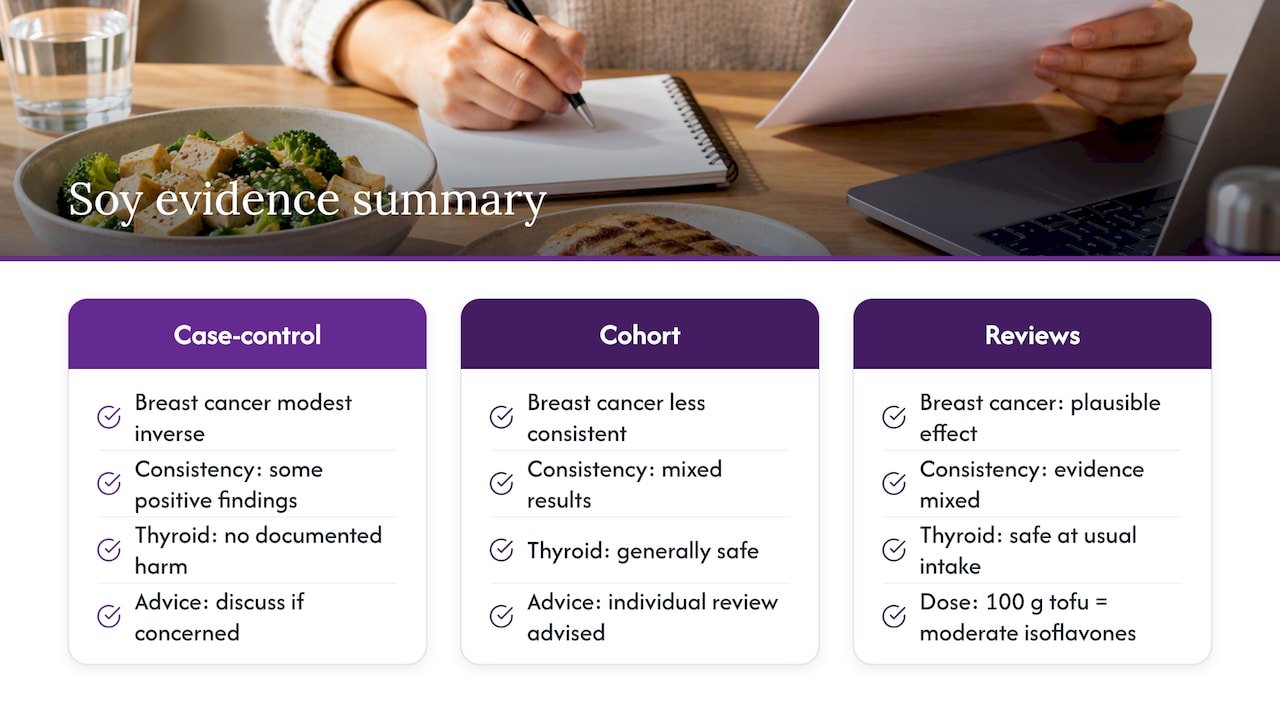
A meta-analysis on tofu intake and breast cancer risk found an inverse association in some observational analyses, with certain case-control studies suggesting a modest risk reduction per 10 grams of daily tofu intake. Cohort studies, which tend to be more rigorous, showed less consistent results. That gap between study types is the honest summary: soy’s potential protective effect against breast cancer is plausible but not settled.
Soy research is extensive and sometimes contradictory, which is why practitioners need concise, current summaries before counselling clients on intake.
A practitioner-focused soy and health review makes that point directly, and it’s a fair caution against treating any single soy study as the final word.
On thyroid and uterine health, the weight of current reviews points toward safety for typical dietary intakes. A standard serving of tofu, about 100 grams, provides a moderate amount of isoflavones, according to the same soyfoods review, a level well within what traditional soy-eating populations have consumed for generations without documented harm to thyroid function.
The practical takeaway: moderate, regular consumption of traditional soyfoods like tofu, tempeh, and soymilk appears safe for most people. If you have a thyroid condition or a hormone-sensitive diagnosis, it’s worth discussing your specific situation with a clinician rather than relying on general guidance. Protein choices also intersect with bone health, a topic covered in more detail by resources on protein and bone density.
How much tofu equals one chicken breast for protein?
Swapping proteins only works if you match the numbers, not just the volume on the plate.
Using the Heart and Stroke Foundation figures as a baseline: an 85-gram chicken breast provides about 25 to 28 grams of protein, while one cup of extra-firm tofu provides about 23 grams. That means roughly one full cup of extra-firm tofu is a reasonable swap for a standard chicken breast portion, with a small protein gap you can close with a side of beans, lentils, or a scoop of yogurt.
Building meals around specific protein targets:
- For a 20-gram protein target, use about three-quarters of a cup of extra-firm tofu, or a smaller 70-gram portion of chicken.
- For a 30 to 40-gram protein target, combine one and a half cups of tofu with a side of legumes, or pair a full chicken breast with a protein-rich side like Greek yogurt or lentils.
- For meal prep consistency, weigh tofu after pressing, since water loss during pressing changes the protein-per-gram math more than most people expect.
Tofu’s fibre content plays a real role in satiety that chicken simply can’t replicate. A meal built around tofu and vegetables tends to feel more filling per calorie than the same calorie count from chicken alone, which matters if your goal is weight management rather than pure muscle-building. For more structured examples, our vegetarian Mexican meal prep ideas walk through several 20 to 40 gram protein templates using tofu as the base.
How do you cook tofu so it actually works like chicken?

Tofu disappoints people mostly because of technique, not the ingredient itself.
Pressing is the first fix: wrap firm or extra-firm tofu in a clean towel, weigh it down for 15 to 30 minutes, and you’ll remove enough water to let it crisp instead of steam. Silken tofu belongs in smoothies and sauces, never on a grill. Extra-firm is the right choice for pan-searing, baking, or air-frying.
- Marinate tofu for at least 20 minutes in a mix with soy sauce, lime, and spices to mimic the savoury depth of seasoned poultry.
- Crumble firm tofu by hand for dishes that call for ground meat, like taco filling or burrito bowls.
- Crisp tofu in an air fryer at 200°C (400°F) for 15 to 20 minutes, flipping once, for a texture close to grilled chicken.
- Avoid overcrowding the pan, which traps steam and keeps tofu soft instead of browned.
Pro Tip: Press tofu the night before and marinate it overnight in the fridge. The extra time lets seasoning penetrate deeper than a quick 20-minute soak ever will. Our guide to keeping tofu crisp in burrito bowls covers three specific methods if you want more detail.
How does a from-scratch kitchen handle tofu as a protein option?
We built our kitchen around the idea that a plant-based protein deserves the same care as a slow-cooked meat, not a token substitution.
Every dish moves through our from-scratch kitchen using Manitoba-produced ingredients, and we operate as a deep-fryer-free restaurant, which matters if you’re choosing tofu specifically to avoid oil-heavy preparation. Our staff are trained to handle dietary restrictions and cross-contamination concerns, which counts for more than menu text when you’re managing a soy allergy or a gluten-free requirement alongside a protein swap.
- Tofu appears as a protein option in burrito bowls, giving you a direct substitute for chicken without changing the rest of the build.
- Preparation method affects outcome: how tofu is pressed, seasoned, and cooked determines whether it satisfies the way chicken does.
- This reflects one example of a kitchen applying these principles in practice, not a claim that any one restaurant’s approach is the only valid method.
If you’re in Winnipeg and want to see how a higher-protein bowl comes together, our guide on ordering high-protein Mexican food walks through the specific combinations that work best.
Why rotating proteins beats picking a permanent winner
Treating this as a contest with one winner misses the point. Tofu and chicken solve different problems: one lowers your saturated fat and adds fibre, the other delivers protein density and B12 you can’t easily get from plants. The healthiest pattern I’ve seen argued convincingly is rotation, not allegiance.
Favour tofu, legumes, and other plant proteins on most days, and reach for chicken when you need a higher protein hit or you’re managing a B12 concern. Try tofu in a dish you already love this week and pay attention to how it affects your fullness and digestion, not just the macros on the label.
— Austin
This article is general information, not a substitute for advice from a qualified doctor. Consult a qualified healthcare professional about your own circumstances before acting on anything here.
FAQ
Is tofu really healthier than meat?
Tofu tends to be lower in saturated fat and cholesterol-free, while offering fibre that meat doesn’t have at all. Whether it’s “healthier” depends on your goal: for heart health and fibre, tofu often wins; for raw protein density and B12, lean meats like chicken have an edge, according to Heart and Stroke Foundation guidance.
Is there a downside to eating tofu?
The main downsides are lower protein density compared with chicken, less bioavailable iron, and a near-total absence of vitamin B12. Calcium content also varies widely depending on whether the tofu was set with a calcium salt, so not all tofu offers the same bone-health benefit.
Is tofu easier to digest than chicken?
For most people without allergies, both are easy to digest, but tofu and tempeh have far lower oligosaccharide content than whole soybeans, which reduces the gas and bloating sometimes linked to soy. Chicken carries no fibre-related digestion concerns but requires careful cooking to 74°C (165°F) to avoid foodborne illness.
How much tofu is equal to one chicken breast?
One cup of extra-firm tofu provides about 23 grams of protein, close to the 25 to 28 grams found in an 85-gram chicken breast, based on Heart and Stroke Foundation figures. A full cup of pressed, extra-firm tofu is a reasonable one-to-one swap for a standard chicken breast portion.