Catering selection is the process of matching your event’s formality, guest count, dietary needs, and budget to the right service style and menu. Get it right and food becomes a highlight. Get it wrong and it overshadows everything else. Whether you are planning a corporate lunch in Winnipeg or a backyard wedding in Brandon, the decisions you make early determine how smoothly the day runs. This guide walks you through every factor that matters, from event catering fundamentals to booking your final contract.
How to choose catering options: key factors first
The right catering choice starts with understanding your event before you look at a single menu. Four factors shape every decision you make after that.
Event type and formality set the tone for service style. A black-tie gala calls for plated service and white-glove staff. A team lunch calls for drop-off or buffet. Getting this wrong creates friction between the food experience and the event atmosphere.

Guest count and demographics drive your budget and menu scope. A group of 20 colleagues has different needs than 200 wedding guests with mixed dietary backgrounds. The larger and more diverse your guest list, the more planning your menu requires.
Venue restrictions are the factor planners most often overlook until it is too late. Many venues restrict catering to approved vendors or in-house staff. Discovering this after you have signed with an outside caterer creates real problems. Confirm venue policies before you shortlist anyone.
Timing and lead times matter more than most planners expect. Most caterers require 24–48 hours notice for standard orders and 3–7 days for larger or custom events. Book early, especially for peak seasons like june and december.
- Confirm your guest count estimate before requesting quotes
- Ask the venue for its approved vendor list on your first call
- Build in at least one week of buffer before your booking deadline
- Identify any guests with severe allergies before finalising the menu
Pro Tip: Ask your venue coordinator for a written copy of its catering policy, not just a verbal answer. Policies vary by room, day of week, and event type.
What are the main catering service styles?
Service style dictates event pacing: plated service suits formal, synchronised meals, while buffets and stations work best for social, mingling events. Choosing the wrong style for your event’s rhythm is one of the most common and costly mistakes planners make.
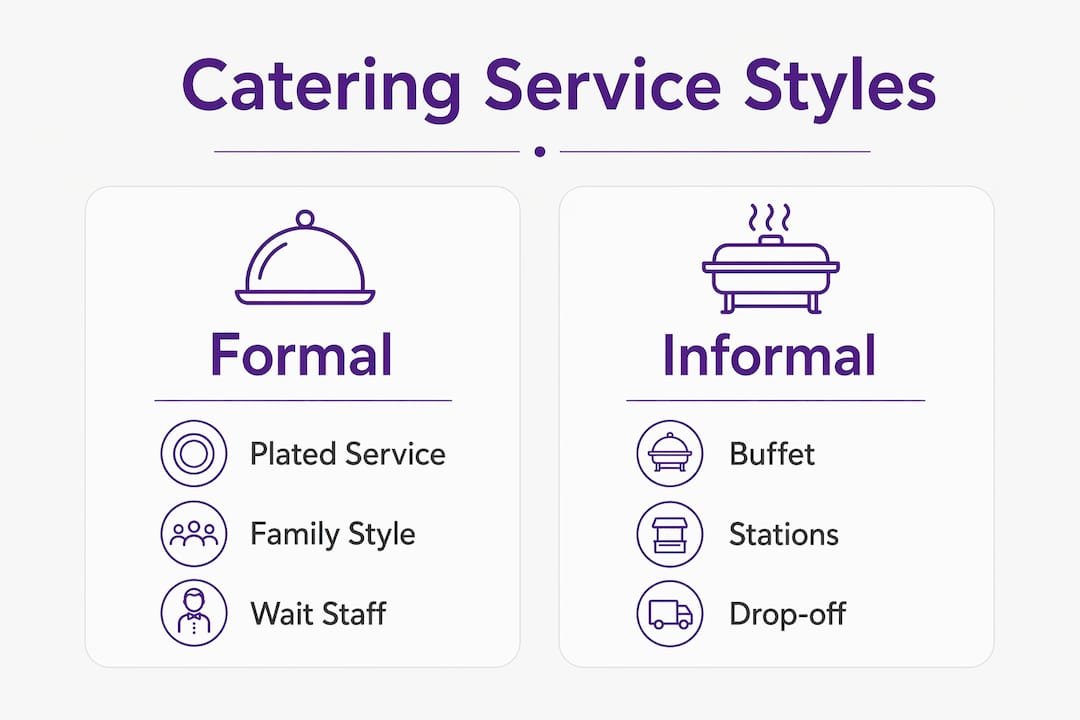
| Service style | Best for | Cost level | Staffing needed |
|---|---|---|---|
| Drop-off | Informal lunches, small offices | Lowest ($10–$25 per person) | None required |
| Buffet | Casual receptions, large groups | Moderate | 1–2 servers |
| Plated | Formal dinners, galas | Highest | Full service team |
| Family-style | Weddings, intimate dinners | Moderate to high | 1–2 servers |
| Stations | Cocktail parties, networking | Moderate | Station attendants |
| Passed appetisers | Cocktail hours, receptions | Moderate | Roving servers |
Drop-off catering is the most cost-effective option for informal events, typically costing $10 to $25 per person. That low price reflects the absence of service staff, setup labour, and teardown costs. It works well for office lunches and casual gatherings but falls short at events where presentation and service are part of the experience.
Buffet and family-style services require approximately 20–30% more food volume than plated service because guests self-serve and tend to take larger portions. That extra volume needs to be priced into your quote from the start. Ignoring it leads to shortages mid-event, which is far more damaging than a slightly higher food cost.
Pro Tip: For events over 80 guests, stations and buffets move faster than plated service. Faster service means less waiting, which guests notice and appreciate.
How do you evaluate catering menus for diverse guests?
A strong catering menu balances variety with theme consistency. Offering ten dishes from five different cuisines creates confusion. Offering five well-executed dishes that share a flavour profile creates a cohesive experience.
Dietary inclusion is no longer optional. Dietary-friendly catering now covers vegetarian, vegan, gluten-free, keto, and allergen-aware options as standard expectations, not special requests. Planners who treat these as afterthoughts end up with guests who cannot eat, which reflects poorly on the entire event.
- Label every dish clearly with allergen information
- Offer at least one protein-rich vegan option, not just a side salad
- Confirm that gluten-free items are prepared separately to avoid cross-contamination
- Include allergen-friendly snack options from suppliers like PopCornaa for cocktail hours
- Plan beverages with the same care as food, including non-alcoholic choices
Seasonal and local ingredients improve both flavour and cost. Caterers sourcing from local producers, like Burritosplendido’s use of Peak of the Market produce and Bothwell Cheese from Manitoba, deliver fresher food at more predictable prices. Local sourcing also reduces the risk of supply chain disruptions affecting your event day menu.
Portion planning requires a formula, not a guess. Plan for 1.5 servings per guest for buffet-style events and 1 serving per guest for plated meals. Add 10% to your total as a buffer for unexpected guests or second helpings at key dishes.
What does catering actually cost?
A standard catering budget allocates 60–70% to food, 15–25% to service and coordination, 10–20% to bar service, and 5–10% to equipment rentals. That breakdown matters because many quotes only show the food cost. The remaining 30–40% can appear as line items you did not expect.
| Budget category | Typical share | What it covers |
|---|---|---|
| Food | 60–70% | Ingredients, preparation, packaging |
| Service and coordination | 15–25% | Staff, setup, teardown |
| Bar service | 10–20% | Beverages, bartenders, glassware |
| Equipment rentals | 5–10% | Tables, linens, serving ware |
Fully itemised quotes reveal hidden costs such as travel fees, gratuities, and equipment rentals that can add 20% or more to the final bill. Always request a line-by-line breakdown before signing anything. A quote that looks low often looks very different once those items appear.
Choosing the lowest price quote often leads to missing services and unexpected costs on event day. The caterer who charges less per head may not include staffing, serving equipment, or cleanup. Those costs do not disappear. They either get added back or they become your problem to solve on the day.
Pro Tip: Ask every caterer to confirm in writing what is and is not included in the quoted price. A one-page summary of inclusions and exclusions takes five minutes to produce and prevents disputes.
Booking early also affects price. Caterers charge more for last-minute bookings because they require expedited sourcing and scheduling. Locking in your caterer 6–8 weeks before the event gives you more negotiating room and better availability.
Step-by-step process to select and book a caterer
A clear process prevents the most common booking mistakes. Follow these steps in order.
- Define your event parameters. Set your guest count, date, venue, and budget ceiling before contacting anyone. Caterers cannot give accurate quotes without this information.
- Confirm venue catering policies. Call the venue before shortlisting caterers. Ask for the approved vendor list and any restrictions on outside food or equipment.
- Request quotes from three or more providers. Compare itemised quotes, not headline prices. Look for what each quote includes and excludes.
- Schedule tastings. Most reputable caterers offer tastings for events above a minimum guest count. Taste before you commit. Food quality on a tasting plate reflects what your guests will receive.
- Check references and reviews. Ask for two or three references from events similar in size and style to yours. Call them. Online reviews tell part of the story; direct conversations tell the rest.
- Confirm service details in writing. Before signing, confirm staff count, arrival time, setup and teardown responsibilities, and what happens if a key staff member cancels.
- Finalise guest counts and dietary needs. Most caterers require a final guest count 5–7 days before the event. Collect dietary information from guests in advance so you can pass it on accurately.
- Build in a contingency plan. Caterers with established vendor networks simplify logistics and often secure better pricing on rentals. Ask your caterer who they work with for equipment and whether those relationships benefit your quote.
Key takeaways
Selecting catering services successfully requires matching your service style, menu, and budget to your event’s specific needs before you contact a single provider.
| Point | Details |
|---|---|
| Confirm venue policies first | Many venues restrict caterers to approved vendors, so check before shortlisting. |
| Match service style to event pace | Plated suits formal events; buffets and stations work better for social gatherings. |
| Request itemised quotes | Hidden fees for travel, gratuities, and rentals can add 20% or more to the final bill. |
| Plan extra food for self-serve styles | Buffet and family-style events need 20–30% more food volume than plated service. |
| Book 6–8 weeks in advance | Early booking improves pricing, availability, and your ability to negotiate. |
What I have learned from watching catering go wrong
The most expensive catering mistakes I have seen had nothing to do with food quality. They came from planners who locked in a caterer before checking venue restrictions, or who accepted a low quote without asking what it excluded. Both situations are entirely avoidable.
The conventional advice is to focus on food first. I disagree. Focus on logistics first. A caterer who cannot access your venue, does not have the right equipment, or arrives without enough staff will ruin an event regardless of how good the food tastes. Vet the operation before you taste a single dish.
I have also seen planners underestimate dietary needs because they assumed most guests would eat anything. At a corporate event I observed in Winnipeg, roughly a quarter of the guests had dietary restrictions that were not communicated to the caterer. The result was a buffet where several guests could not eat the main dishes. That is not a food problem. That is a planning problem.
The best caterers I have encountered work like project managers. They ask detailed questions, provide written confirmations at every stage, and have backup plans for equipment failures and staff shortages. If a caterer cannot answer your logistics questions clearly, that tells you everything you need to know about how they will perform on event day.
— Austin
Burritosplendido’s catering: fresh, local, and built for events
Burritosplendido brings its “fresh, local, and doing the right thing” philosophy directly to event catering across Winnipeg and Brandon.
Every catering order is built from the same from-scratch kitchen that serves Burritosplendido’s restaurant guests daily. That means house-pressed tortillas made with 100% Manitoba flour, slow-cooked proteins like Carnitas and Barbacoa, and produce sourced through Peak of the Market. The menu covers burritos, burrito bowls, street-style tacos, and quesadillas, all fully customisable for gluten-free, vegan, and keto guests. Pricing is transparent and the ordering process is straightforward. Browse the full catering menu and options online or contact Burritosplendido directly to discuss your event’s specific needs.
FAQ
What is the most affordable catering service style?
Drop-off catering is the most cost-effective option, typically costing $10 to $25 per person. It suits informal events because it requires no service staff, setup, or teardown labour.
How far in advance should I book a caterer?
Book at least 6–8 weeks before your event for the best availability and pricing. Most caterers require 3–7 days notice for larger or custom orders at minimum.
How do I accommodate dietary restrictions in catering?
Collect dietary information from guests before finalising your menu, then confirm with your caterer that gluten-free and allergen-sensitive items are prepared separately to prevent cross-contamination.
Why do catering quotes vary so much in price?
Quotes differ because some include staffing, equipment, and gratuities while others cover food only. Always request a fully itemised quote to compare true costs across providers.
How much extra food do I need for a buffet?
Plan for approximately 20–30% more food volume than you would for a plated meal. Guests self-serving at a buffet consistently take larger portions than a plated service provides.