If cilantro tastes like soap to you, you’re not imagining it and you’re not being dramatic. A specific genetic variation in your olfactory receptors causes certain aldehydes in cilantro to register as soapy rather than fresh. The trait is real, biological, and more common than most people assume — but it’s not necessarily permanent.
The short version:
- A variant near the olfactory receptor gene OR6A2 changes how your nose processes cilantro’s volatile compounds.
- The culprit chemicals are aldehydes like (E)-2-decenal and (E)-2-dodecenal, the same class of compounds used in manufactured soaps and fragrances.
- Roughly 3%–21% of people perceive cilantro as soapy, depending on ancestry and how the question is asked.
- Genetics accounts for only about 8.7% of the variation in preference, which means environment, exposure, and preparation matter enormously.
- Practical fixes exist: cook the herb briefly, chop it fine, pair it with fat or acid, or swap in flat-leaf parsley.
Key takeaways
| Point | Details |
|---|---|
| Genetic cause | A variant near OR6A2 makes some people detect cilantro’s aldehydes as soapy rather than herbal. |
| Chemical mechanism | Aldehydes like (E)-2-decenal and (E)-2-dodecenal overlap chemically with soap and fragrance compounds. |
| How common it is | Roughly 3%–21% of people perceive cilantro as soapy, varying by ancestry and cultural exposure. |
| It can change | Heritability is only ~8.7%; cooking, chopping, and repeated exposure can reduce the soapy effect for many. |
| Practical fix | Cook cilantro briefly, use stems over leaves, or substitute flat-leaf parsley with mint and lime. |
Table of Contents
- Why does cilantro taste like soap? The OR6A2 gene explained
- Which chemicals in cilantro actually smell soapy?
- How common is the soapy-cilantro perception?
- Can the soapy perception change over time?
- Other factors that shape how cilantro tastes to you
- What the key studies actually show, and where the evidence falls short
- A simple at-home test to gauge your aldehyde sensitivity
- An editorial perspective on cooking and hosting with cilantro in mind
- Sources
Why does cilantro taste like soap? The OR6A2 gene explained
The scientific term for cilantro is Coriandrum sativum, and the plant produces a suite of volatile aldehydes as part of its aroma profile. For most people, those compounds read as bright, citrusy, and herbal. For a meaningful minority, the same molecules trigger a perception of soap or dish detergent. The difference comes down to which olfactory receptors you inherited.
A 2012 genome-wide association study conducted in over 14,000 participants (with replication in roughly 11,800 more) identified a single nucleotide polymorphism, rs72921001, located near a cluster of olfactory receptor genes on chromosome 11. The receptor gene OR6A2 sits within that cluster and is the strongest candidate for binding the aldehydes responsible for cilantro’s aroma. People who carry certain variants of OR6A2 appear to detect those aldehydes with higher sensitivity, and their brains categorise the signal as soapy rather than herbal.
That figure is worth sitting with. It means genetics explains less than one-tenth of the variation in cilantro preference across a population. The rest is shaped by cultural exposure, cooking context, and learned association.
What the biology looks like, step by step:
- Volatile aldehydes released from cilantro leaves travel to the olfactory epithelium in the nasal cavity.
- OR6A2 (and possibly related receptors) binds those aldehydes and sends a signal to the olfactory bulb.
- The olfactory bulb relays the signal to the brain’s cortex, where it’s interpreted as either “fresh herb” or “soap,” depending on receptor sensitivity and prior experience.
- People with the rs72921001 variant appear to have a lower threshold for detecting these compounds, making the soapy note dominant.
Research from the University of Toronto also suggests the trait is likely polygenic rather than single-gene, with additional loci including OR4N5 and TAS2R1 contributing in some populations. There is no single “soap gene” — OR6A2 is the strongest signal found so far, not the whole story.
Which chemicals in cilantro actually smell soapy?
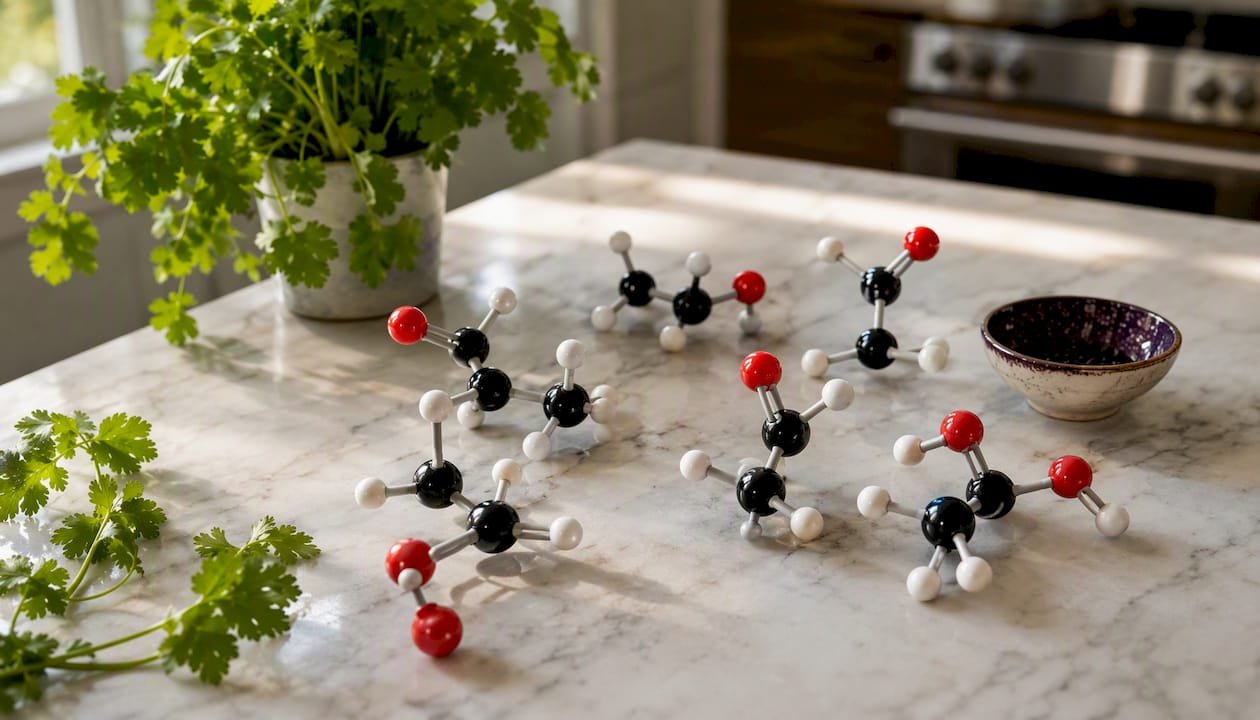
The aldehydes in cilantro are the direct chemical cause of the soapy perception. Flavour chemistry analyses of Coriandrum sativum consistently identify a group of unsaturated and saturated aldehydes as the dominant aroma contributors:
- (E)-2-decenal — a ten-carbon unsaturated aldehyde with a fatty, soapy, citrus-peel character
- (E)-2-dodecenal — a twelve-carbon unsaturated aldehyde with a similar profile, often described as waxy or soapy
- Decanal — a saturated ten-carbon aldehyde with orange-peel and soapy notes
- Dodecanal — a saturated twelve-carbon aldehyde with a floral, soapy quality
Laboratory receptor studies confirm that (E)-2-decenal is a high-affinity ligand for olfactory receptors implicated in cilantro detection, which ties the chemistry directly to the receptor biology.
“At low concentrations, aldehydes can smell bright and citrusy. At higher perceived intensity — or with a receptor that amplifies the signal — those same compounds become sharp, soapy, or metallic.” This concentration-dependent shift explains why the same herb smells completely different to two people standing at the same cutting board.
The overlap with soap is not coincidental. Manufacturers use long-chain aldehydes in soap and fragrance formulations because of their clean, fresh scent. If your OR6A2 variant makes you particularly sensitive to this class of compound, cilantro essentially smells like the inside of a soap factory. The American Chemical Society’s ChemMatters notes this connection directly: the aldehydes in cilantro and the aldehydes in soap are chemically related, which is why the perceptual overlap is so precise rather than vague.
How common is the soapy-cilantro perception?
Prevalence estimates vary considerably across studies, and that variability is itself informative. The range reported in the literature runs from roughly 3% to 21%, depending on the population studied and how the question was framed.
| Population group | Approximate prevalence of soapy perception | Notes |
|---|---|---|
| East Asian ancestry | ~21% | Higher reported rates; lower traditional culinary use of cilantro |
| Caucasian/European ancestry | 3%–21% | Moderate rates; variable cultural exposure |
| South Asian ancestry | 8.7% | Lower rates; cilantro widely used in regional cuisines |
| Hispanic/Latino ancestry | ~4%–5% | Among the lowest rates; cilantro central to culinary tradition |
| Middle Eastern ancestry | ~3% | Very low; high culinary exposure from early childhood |
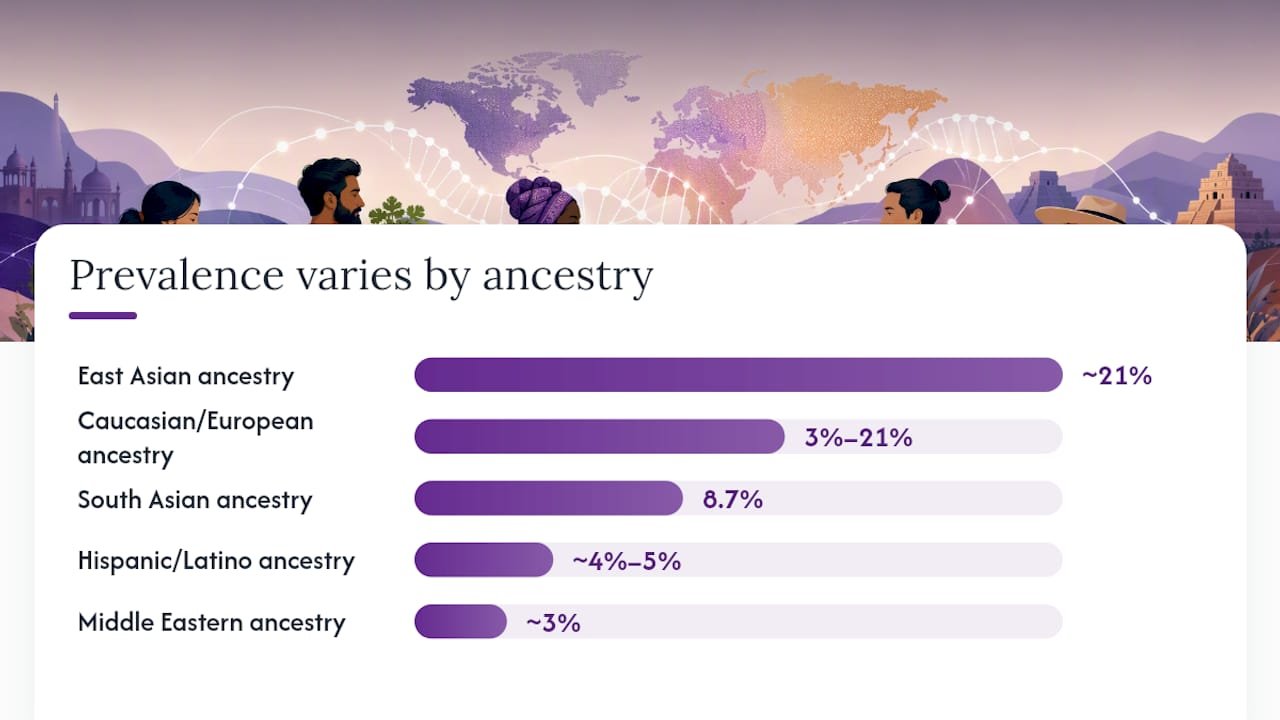
Sources: Europe PMC review; Eriksson et al. 2012 GWAS.
A few things explain the spread:
- Self-report bias. People who grew up eating cilantro regularly may not notice or articulate a soapy quality even if they carry the relevant variant.
- Cultural exposure. Populations where cilantro is a dietary staple from infancy tend to report lower aversion, consistent with the low heritability estimate.
- Question framing. Studies that ask “does cilantro taste like soap?” get different response rates than those asking about general cilantro preference.
The pattern across groups is consistent with the genetics: ancestry-linked allele frequencies partly explain the differences, but so does the degree to which a culture has normalised the herb’s flavour through repeated exposure.
Can the soapy perception change over time?
Yes, for many people it can. The Cleveland Clinic notes that genetics provides a predisposition, not a fixed sentence — preference can shift through repeated positive exposure and through preparation methods that reduce aldehyde intensity.
Stepwise strategies to reduce the soapy effect:
- Cook it. Heat breaks down volatile aldehydes. Add cilantro to a hot pan or stir it into a warm dish rather than using it raw. The soapy note diminishes significantly once the most volatile compounds disperse.
- Chop or crush finely. Mechanical disruption releases and disperses aldehydes quickly, which can reduce their perceived concentration in the final dish. Serious Eats recommends this as one of the most accessible preparation adjustments.
- Use stems instead of leaves. The leaves carry a higher concentration of volatile aldehydes than the stems. Stems add a milder herbal note without the same intensity.
- Pair with fat or acid. Fat coats the palate and blunts volatile perception. Acid (lime juice, vinegar) can shift the overall flavour balance so the soapy note is less dominant.
- Start small and build gradually. Repeated low-dose exposure can recalibrate how your brain categorises the smell. This is the habituation pathway — not guaranteed, but documented.
Practical substitutes when you’d rather skip cilantro entirely:
- Flat-leaf parsley is the most direct swap for texture and colour. It lacks the aldehyde profile entirely.
- Parsley + fresh mint + lime zest together approximate cilantro’s brightness in salsas and tacos. For a cilantro substitute for tacos, this combination holds up well.
- Thai basil works in Southeast Asian-influenced dishes where cilantro would otherwise appear.
- Culantro (Eryngium foetidum) has a similar flavour but a different aldehyde profile; some people who dislike cilantro tolerate it better.
Pro Tip: Crush a small amount of cilantro with a mortar and pestle, then stir it into warm oil or butter for 30 seconds before adding other ingredients. The heat and fat together dramatically reduce the soapy aldehyde load while preserving the herb’s green, citrusy undertones.
Other factors that shape how cilantro tastes to you
OR6A2 gets most of the attention, but it’s not the only variable. Several other biological and environmental factors influence how intensely you perceive cilantro’s aldehydes.
- Supertaster status. People who are sensitive to PROP (6-n-propylthiouracil) or PTC (phenylthiocarbamide) tend to have a higher density of fungiform papillae on the tongue and heightened chemosensory sensitivity overall. This amplified sensitivity can make the soapy or bitter notes in cilantro more pronounced, even without a specific OR6A2 variant.
- Age-related changes. Smell sensitivity generally declines with age, which means older adults may find cilantro less offensive than they did in their twenties. Conversely, children often have sharper olfactory responses and may be more likely to report the soapy quality.
- Cultural and dietary history. Populations with long culinary traditions involving cilantro — South Asian, Mexican, Middle Eastern — show lower aversion rates. Early and repeated exposure appears to train the brain to categorise the aldehydes as food rather than soap. Britannica’s overview of the topic notes this cultural dimension as a key explanatory factor.
- Context effects. Raw cilantro on a cold dish presents aldehydes at full intensity. The same herb stirred into a warm curry or braised dish delivers a fraction of that volatile load. The preparation context changes the perceived flavour even for the same person.
What the key studies actually show, and where the evidence falls short
The scientific picture is solid in outline but still has meaningful gaps.
| Study / source | What it demonstrates | Main limitation |
|---|---|---|
| Eriksson et al. 2012 GWAS (Flavour, Springer) | rs72921001 near OR6A2 associated with soapy perception; heritability ~8.7% | Self-report outcome measure; effect size modest; primarily European-ancestry cohort |
| TSpace genetic analysis (University of Toronto) | Additional loci (OR4N5, TAS2R1) suggest polygenic architecture | Thesis-level work; smaller sample; replication limited |
| Europe PMC population review | Prevalence varies 3%–21% by ancestry and cultural exposure | Heterogeneous methods across studies; no standardised sensory protocol |
| PMC flavour chemistry study | (E)-2-decenal identified as high-affinity ligand for implicated receptors | In vitro binding; does not fully replicate in-vivo perception complexity |
The 2012 GWAS by Eriksson and colleagues remains the most-cited anchor point. It was large, replicated, and identified a credible biological mechanism. But the effect size is modest and the heritability estimate low, which means no genetic test can reliably predict whether you’ll find cilantro soapy. The absence of a single definitive molecular blocker also means there’s no pharmacological fix on the horizon. What the evidence does support clearly is that preparation, exposure, and context are the most practical levers available.
A simple at-home test to gauge your aldehyde sensitivity
If you’re unsure whether your cilantro aversion is aldehyde-driven or just a general dislike, a controlled comparison can help clarify it.
- Get fresh cilantro. Use a bunch purchased the same day so volatile compounds are at peak concentration.
- Crush one leaf between your fingers and smell it directly. Note whether the aroma reads as soapy, metallic, or fresh and citrusy.
- Chop a small amount finely and let it sit for two minutes. Smell again. Some people notice the intensity shifts as volatiles disperse.
- Cook a small pinch in a warm pan for 20–30 seconds, then smell. If the soapy quality drops noticeably compared to the raw sniff, aldehyde sensitivity is likely the cause.
- Taste a small amount raw, then taste the cooked version. If raw tastes soapy but cooked tastes herbal or neutral, you have a practical workaround.
Expected outcome: people with OR6A2-related sensitivity typically find the raw, crushed leaf most offensive. Cooking reduces the effect for many of them. If both raw and cooked versions taste equally soapy, other factors (general bitterness sensitivity, supertaster status) may also be at play.
Note: Skip this test if you have a known allergy to herbs in the Apiaceae family (which includes cilantro, parsley, and celery) or any respiratory sensitivity to volatile plant compounds. If you experience any reaction, consult a medical professional.
The 3%–21% prevalence range across populations means that at a dinner table of ten people, anywhere from zero to two guests might find cilantro genuinely unpleasant — a useful reminder that the reaction is common enough to plan around.
An editorial perspective on cooking and hosting with cilantro in mind
The science here has a direct practical implication that most recipe writers and hosts overlook: cilantro aversion is not a preference quirk, it’s a sensory reality for a meaningful share of your guests. Treating it like a minor fussiness is the wrong frame.
When I’m thinking about how to handle cilantro in a shared meal, the single most useful rule is to serve it on the side whenever it’s being used as a garnish. This costs nothing and removes the problem entirely for anyone sensitive. Stirring it into a sauce or a bowl that can’t be separated is where the trouble starts. For dishes where cilantro is structural — a salsa verde, a chutney — the parsley-mint-lime combination holds up well enough that most guests won’t notice the swap.
There’s also a hosting dimension worth naming. Labelling dishes at a gathering (“contains cilantro”) is a small act of consideration that people with strong aversions genuinely appreciate. It’s the same logic as labelling nut-containing dishes: the stakes are lower, but the courtesy is identical. At Burritosplendido, every menu item is customisable, and cilantro can be left out or served on the side — which is exactly the right approach for a restaurant that takes ingredient transparency seriously. If you’re planning a group meal or event and want that same flexibility built in, Burritosplendido’s catering service handles dietary preferences at scale without anyone having to pick around their food.
The broader point is that understanding the genetics doesn’t just satisfy curiosity. It reframes the conversation. Someone who finds cilantro soapy isn’t being difficult — their olfactory receptors are doing exactly what they were built to do. That’s worth knowing before you dismiss the complaint.
Sources
- A genetic variant near olfactory receptor genes influences cilantro preference | Flavour | Springer Nature Link
- Why Does Cilantro Taste Like Soap to Some People—and Can You Fix It?
- Can a Gene Cause Cilantro To Taste Like Soap? | Cleveland Clinic Health
- Human populations are polymorphic for a qualitative difference in organoleptic response to coriander leaves (review / article) | Europe PMC
- Genetic Determinants of Cilantro Preference | TSpace Repository