Flat-leaf parsley plus a splash of lime is the quickest and most reliable cilantro substitute in salsa. Swap it in at a 1:1 ratio and add lime juice to bring back the citrus lift you’d lose otherwise. For fruit or roasted salsas, basil or mint work better than parsley. Each swap shifts the flavour a little, so read on for recommended amounts and technique before you commit a whole batch.
TL;DR:
- Flat-leaf parsley is the most reliable cilantro substitute in salsa, best used with lime juice to mimic citrus brightness.
- Basil and mint are suitable for fruit salsas, with basil adding sweetness and mint providing a cooling effect, but require careful quantity control.
- Adjust herb ratios based on salsa type, with parsley at a 1:1 ratio and mint or dill used in smaller amounts, added just before serving for optimal freshness.
- Rebuilding cilantro’s citrus note involves adding lime or lemon juice, apple cider vinegar, or toasted coriander seed, with balancing sugar if needed.
- Successful substitution depends on matching the herb to the salsa style and taste-testing incrementally throughout preparation.
Table of Contents
- Top fresh substitutes for cilantro in a no cilantro salsa
- How to bring back cilantro’s citrus snap
- Which herb substitute fits which salsa style
- Getting the ratios and timing right
- Cilantro-free pico de gallo: a quick recipe
- How Burrito Splendido handles cilantro-free salsas in the kitchen
- Experiment, but taste as you go
- Order it made right, cilantro or not
- Sources
- FAQ
Top fresh substitutes for cilantro in a no cilantro salsa
Not every herb does the same job, so picking the right one for your salsa depends on what you’re making and why you’re avoiding cilantro in the first place. Some people just don’t have any in the fridge. Others find it tastes like soap, a reaction tied to specific genetics rather than pickiness.
- Flat-leaf (Italian) parsley: The closest texture match to cilantro, with a similar leaf shape and a clean, grassy bite. Parsley is the substitute most commonly recommended for fresh salsas because it holds up to chopping without wilting fast. Use it 1:1 by volume, then stir in ½ to 1 teaspoon of lime juice per cup of chopped herb to replace the citrus note parsley doesn’t naturally carry.
- Basil: Sweeter and more floral than cilantro, which makes it a strong match for tomato-forward salsas and anything built around mango or peach. Swap 1:1, but expect a rounder, less sharp flavour. Basil bruises easily, so tear it rather than mincing it fine.
- Mint: Bright and cooling, best kept to fruit salsas rather than tomato-based ones. Start with half the cilantro amount. Mint is potent, and too much reads as toothpaste rather than herb. Pair it with lime or a pinch of toasted coriander seed to fill in the gap mint leaves on its own.
- Chives or green onions: These bring back the oniony lift cilantro contributes without adding a strong competing flavour. Use the green parts only, sliced thin, roughly equal in volume to the cilantro you’re replacing.
- Dill: Distinctive and a little polarizing in its own right, but it works in small doses. A splash of apple cider vinegar helps balance dill’s anise-like edge so it doesn’t dominate the bowl.
- Carrot greens: An underused option with an earthy, parsley-adjacent flavour and a bit of natural bitterness. Use less than you think you need, and add a touch of extra acid to keep that bitterness from taking over.
Basil and mint particularly suit fruit salsas, while parsley and chives sit more comfortably in classic tomato-based versions.
How to bring back cilantro’s citrus snap
Cilantro isn’t just an herb in salsa. It’s doing double duty as a bright, almost citrusy top note that ties the acid and salt together. Losing it means you have to rebuild that brightness some other way.
- Lime juice is the first move. Start with 1 to 2 teaspoons per cup of salsa and taste before adding more.
- Lemon works in a pinch, though it’s sharper and less floral than lime.
- A splash of apple cider vinegar adds tang without the sweetness lime carries.
- Toasted, ground coriander seed mimics cilantro’s citrusy top note surprisingly well. Use just 1/8 to 1/4 teaspoon per cup. Increasing acidity and adding a small pinch of ground coriander is one of the more effective ways to fake cilantro’s presence when it’s simply not in the bowl.
- If the extra acid tastes too sharp, a pinch of sugar and a touch more salt usually pulls it back into balance.
Pro Tip: Toast coriander seed in a dry pan for about 30 seconds before grinding it. Raw coriander seed tastes dusty; toasted, it smells like citrus peel.
Which herb substitute fits which salsa style
A swap that works in pico de gallo can fall flat in a roasted salsa, and vice versa, so match the herb to the style rather than defaulting to the same one every time.
- Pico de gallo: Parsley plus extra lime is the safest bet. Sliced green onion adds texture that mimics the bite cilantro usually contributes.
- Roasted salsa roja: Oregano or chives work here. If you’ve cut back on cilantro’s brightness, a light dusting of smoked paprika can add depth to make up for it.
- Salsa verde: Flat-leaf parsley pairs well with tomatillo’s natural tartness. Add it near the end of blending so it stays bright rather than turning grassy and dull.
- Fruit salsas (mango, peach, pineapple): Mint pairs best with lime, while basil’s sweeter notes suit stone-fruit combinations better than mint does. A small pinch of sugar smooths out any sharp edges from the added acid.
Getting the ratios and timing right
Getting a substitute herb to taste right in salsa comes down to three things: how much you use, how fine you chop it, and when you add it.
- Ratios: Parsley swaps 1:1 with cilantro. Basil goes 1:1 in fruit salsas. Mint needs half to a full ratio depending on how strong your batch is running. Dill should stay light, around a quarter to half the amount of cilantro called for.
- Chop size: Fine mince for pico de gallo, where texture needs to disappear into the mix. Larger, torn pieces for chunky fruit salsas, where you want the herb visible and distinct.
- Timing: Add delicate herbs like basil and mint right before serving so they don’t wilt or discolour. Hardier herbs like parsley and dill can rest in the bowl for an hour or two without losing much character. Blended salsas, like a smooth roja, tolerate herbs added earlier in the process since the texture is already broken down.
- Storage: For big batches, keep the herb separate until just before serving, especially if you’re making a cilantro-free version alongside a regular one. Refrigerated fresh salsa is best eaten within three to four days. If you want herbs on hand later, freeze them chopped in a little oil.
Pro Tip: If you’re prepping for a party, blitz your substitute herb with olive oil and freeze it in an ice cube tray. Drop a cube into the salsa right before serving for a fresher hit than pre-chopped herb sitting in the fridge.
Cilantro-free pico de gallo: a quick recipe
This one uses the parsley and lime combination from above, scaled for a standard bowl.
- Dice 2 cups of Roma tomatoes and drain briefly in a strainer to avoid a watery salsa, especially important if you’re making a bigger batch for canning or freezing.
- Finely dice ¼ cup white onion and mince 1 jalapeño, seeds removed for less heat.
- Chop ⅓ cup flat-leaf parsley fine and add it to the bowl.
- Squeeze in the juice of 1 to 2 limes, starting with less and tasting as you go.
- Season with ½ teaspoon salt, then taste and adjust acid and salt together.
- Let it rest 10 minutes before serving so the flavours settle. It keeps refrigerated for up to four days.
How Burrito Splendido handles cilantro-free salsas in the kitchen
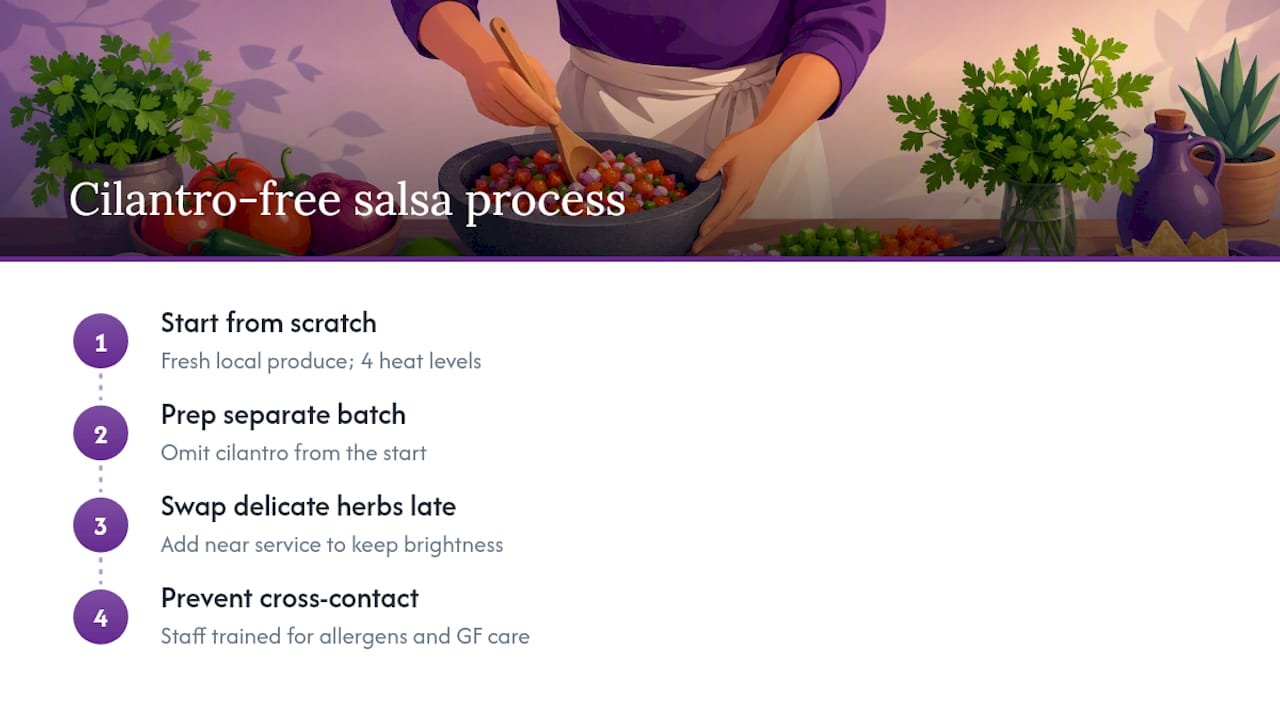
Every house salsa at Burrito Splendido starts from scratch, made fresh with locally sourced produce and available across four different heat levels. When a batch needs to skip cilantro, the kitchen preps it separately from the start rather than trying to pick herb out later, and delicate herb swaps go in close to service time to keep them bright. Staff are trained to manage cross-contamination for guests with specific dietary needs, the same care applied across the gluten-free and allergen-conscious parts of the menu.
Experiment, but taste as you go
Cilantro substitutes aren’t a like-for-like swap, and pretending otherwise sets you up to be disappointed. Parsley gets you close on texture, basil and mint pull a salsa in a sweeter direction, and none of them taste exactly like cilantro on their own. Add your substitute in small increments, lean on acid and salt to fill gaps, and taste constantly rather than trusting a fixed ratio. A different herb doesn’t ruin a salsa. It just makes a different one, and that’s often worth trying on purpose.
— Austin
Order it made right, cilantro or not
Skipping cilantro at home means testing ratios, chasing acid balance, and hoping the batch doesn’t taste flat by the time you’re done. A from-scratch kitchen already does that work daily, pressing tortillas with local flour and building house-made salsas across multiple heat levels, cilantro-free on request.

If you’d rather skip the trial-and-error entirely, check the full menu to see what’s fresh today, or look into catering options if you need a cilantro-free batch scaled up for a party or event. The Bueno Burrito Bar and Burrito Express packages both come with customizable salsa choices, so you can specify exactly what goes into the bowl before your guests ever taste it.
Sources
- Can You Leave Cilantro Out of Salsa: A Comprehensive Guide to Salsa Making Without the Polarizing Herb – KitchenPearls
- Can You Make Salsa Without Cilantro? Yes, And It Still Tastes Great | ShunCy
- Gardeningsolutions
- Canning tomatoes guidance (New Mexico State University Extension)
FAQ
Can you leave cilantro out of salsa?
Yes, cilantro is a flavour choice, not a structural ingredient, so leaving it out entirely won’t hurt the salsa’s texture or safety. Many people who find cilantro tastes soapy omit it permanently without any issue, and traditional pico de gallo recipes have long existed with and without it.
What can I use if I don’t have cilantro?
Flat-leaf parsley with a bit of extra lime is the closest all-purpose swap, and it works in almost any salsa style. For fruit-based salsas, basil or mint fit better and give a sweeter, brighter result.
What happens if I use parsley instead of cilantro?
You get a very similar texture and a clean, grassy flavour, but you lose cilantro’s citrusy edge. Adding ½ to 1 teaspoon of lime juice per cup of chopped parsley closes that gap fairly well.
Is there another herb that tastes like cilantro?
Culantro comes closest in flavour family, but it’s a different, more pungent plant that’s harder to find in most grocery stores. For everyday cooking, parsley plus lime and a pinch of toasted coriander seed gets you a more practical result.