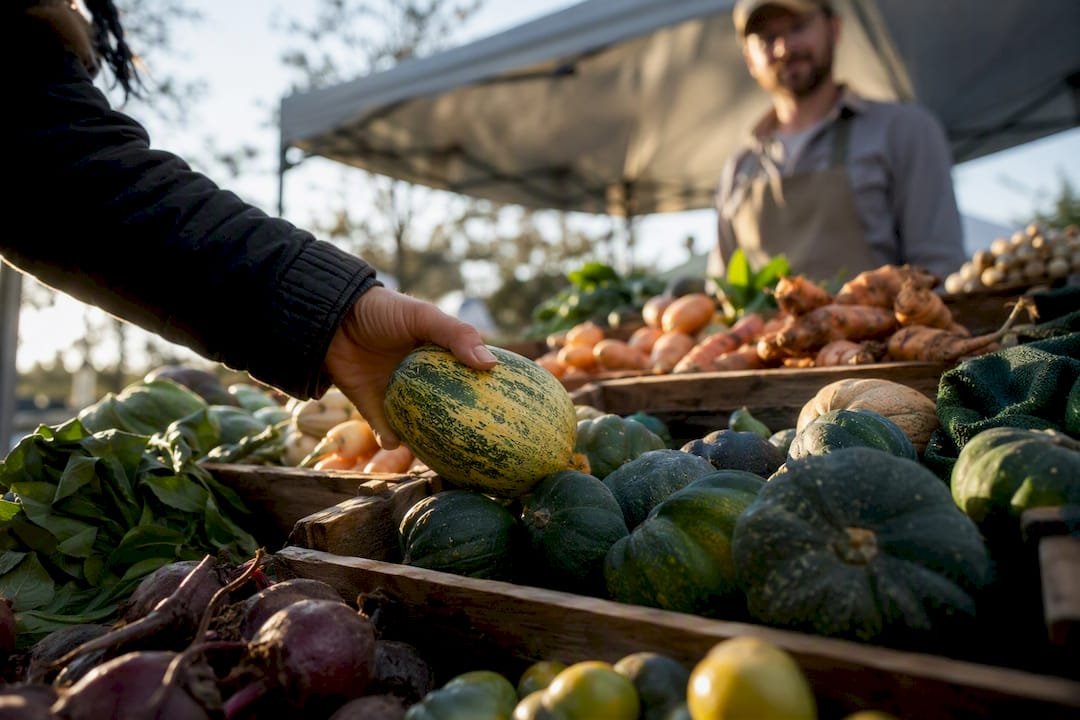
If pesticide residue is your main worry, buy certified organic for high-residue crops like strawberries and spinach. If freshness, flavour, and keeping money in your regional economy matter more, buy local, especially for anything perishable. Neither label beats the other across the board. The right call depends on the crop and what you’re actually trying to fix.
TL;DR:
- Organic certification ensures no synthetic pesticides and verified farm practices, but does not guarantee short travel distance or peak freshness.
- Buying local often means shorter time from harvest to sale and supports regional economies, but does not automatically mean fewer pesticides or higher quality.
- For pesticide reduction, organic produce consistently has lower residue levels, but the long-term health benefits remain uncertain.
- In environmental impact, soil health practices typically weigh more than shipping distance, making production methods more crucial than farm proximity.
- Nutritional differences between organic and conventional vary by crop, so purchase decisions should prioritize specific concerns like pesticide exposure or freshness over labels alone.
Table of Contents
- Organic vs local food: what each label actually guarantees
- What does the health evidence actually say?
- How do food miles compare to soil carbon and farming methods?
- Which crops should you buy organic, and which should you buy local?
- How do you verify what a farmer or vendor actually does?
- Do organic and local farming affect wildlife and biodiversity differently?
- What do local food purchases actually do for farmers and communities?
- How does seasonality change what “local” actually gets you?
- How restaurants apply the organic vs local trade-off
- Editorial perspective: the false choice nobody warned you about
- Try local, from-scratch Mexican food built on the same principle
- Sources
- FAQ
Organic vs local food: what each label actually guarantees
“Organic” is a regulated production method. “Local” is a description of distance, and in most jurisdictions, not even a legally defined one.
In Canada, organic certification means a farm followed specific rules verified by an accredited body: no synthetic pesticides, no genetically modified inputs, and regular inspections tied to the Canadian Food Inspection Agency’s organic product standards. A certified organic tomato grown in Mexico and shipped 3,000 kilometres to your grocery store is still, by definition, organic. Certification says nothing about how far the product travelled or how many days sat between harvest and shelf.
“Local” works the opposite way. There’s no federal legal definition of the term, and in practice it’s used loosely, sometimes tied to a specific province or region, sometimes to an informal radius people throw around (400 miles gets mentioned a lot, though nobody’s enforcing it). A “local” farm can spray as heavily as any conventional operation, or it can quietly follow organic-style practices without ever paying for certification. Proximity tells you about the supply chain, not the spray schedule.
Here’s a quick reference for the checkout line:
- Organic guarantees: no synthetic pesticides, no GMOs, third-party inspection, verified paper trail.
- Organic does not guarantee: short travel distance, peak freshness, or support for a nearby farmer.
- Local typically means: shorter time from harvest to sale, more transparency, money staying closer to home.
- Local does not mean: low-spray, pesticide-free, or independently verified.
- Both labels can overlap: a small regional farm can be certified organic, and often the best answer is finding one that is.
What does the health evidence actually say?
The strongest available evidence shows organic produce carries measurably lower pesticide residue, but the leap from “lower residue” to “better health outcomes” is where the science gets thin.
A systematic review of organic versus conventional food consumption and health outcomes found organic foods had lower pesticide residues and lower levels of certain toxic metabolites in people who ate them. That part is well established. What the same review could not confirm was a clear, consistent link between organic consumption and better long-term health outcomes, like reduced cancer risk or improved chronic disease markers. The residue difference is real; the downstream health payoff is still murky.
The residue gap is measurable, the health payoff is not (yet). Reviewers consistently find lower pesticide residue in organic produce, but long-term outcome data remains limited and mixed.
Nutrient content tells a similarly split story. Some studies show modest bumps in certain antioxidants or omega-3 fatty acids in organic dairy and meat. Others find no meaningful difference in vitamin or mineral content between organic and conventional versions of the same crop. Mayo Clinic’s review of organic food claims lands in a similar place: less pesticide exposure, yes, but nutrient advantages that are inconsistent enough that you shouldn’t buy organic milk expecting a dramatically different nutritional profile from conventional.
Here’s the part shoppers miss most often:
- Local does not automatically mean lower residue. A local farm using conventional pesticide programs can carry the same chemical load as a big commercial grower.
- Organic certification is the only credible guarantee tied to spray practices, regardless of where the food was grown.
- If your goal is minimizing pesticide exposure specifically, the production method matters more than the postal code.
How do food miles compare to soil carbon and farming methods?
Distance is the easiest number to picture, and it’s often the wrong one to obsess over.
Transport emissions are real. But according to Green America’s comparison of organic and local food impacts, production practices, particularly how much carbon a farming system pulls into the soil, often carry more environmental weight than the truck route. Organic systems tend to build organic matter in soil through crop rotation, cover cropping, and compost use, which sequesters carbon and improves soil health over time. A conventional farm 50 kilometres away isn’t automatically greener just because the delivery truck used less fuel.
Refrigeration and packaging complicate the picture further. A large-scale organic supply chain benefits from efficient cold storage and consolidated shipping, spreading emissions across huge volumes. A small local farm selling at a Saturday market might skip the long-haul truck entirely, but if produce is refrigerated inefficiently, wrapped individually, or driven in small batches by multiple vendors, the per-item footprint isn’t automatically smaller. Scale cuts both ways.
A practical way to sort this out:
- Prioritize production method when you’re buying shelf-stable or long-storage items (grains, dried beans, root vegetables) where soil practices matter more than transit time.
- Prioritize proximity for delicate, quickly perishable items where cold-chain losses and spoilage waste are the bigger environmental cost.
- Watch packaging, not just distance. A plastic-wrapped organic import and a loose, unpackaged local vegetable are not on equal footing environmentally.
For a broader look at how supply chains factor into these trade-offs, Wild Foodz’s breakdown of local sourcing is worth a read if you want the logistics side spelled out further.
Which crops should you buy organic, and which should you buy local?
Not every crop deserves the same decision. Some produce absorbs far more pesticide residue than others simply because of skin structure, and some lose flavour and nutrients fast enough that the calendar matters more than the certification sticker.
- Buy organic for thin-skinned, high-residue crops. Strawberries, spinach, kale, peaches, and apples consistently test higher for pesticide residue than thicker-skinned produce. If your budget only stretches to a few organic purchases, put them here.
- Buy local for anything that degrades fast. Tomatoes, corn, berries, and leafy greens lose flavour and nutrients quickly after harvest. Local produce reaching your table in 24 to 48 hours, as opposed to conventional supply chains that can take a week or more, holds onto vitamin C and folate better, according to CollectiveCrop’s comparison of local and organic food priorities.
- Relax the organic requirement for thick-skinned produce. Avocados, onions, pineapple, and cabbage naturally carry lower residue loads, so conventional versions are a reasonable place to save money.
- Stretch your budget with seasonal and frozen options. Buying in-season local produce cuts cost and boosts flavour, and frozen organic vegetables, picked and frozen near peak ripeness, often outperform out-of-season “fresh” organic on both nutrition and price, per Mayo Clinic’s guidance on organic food budgeting.
- Consider a CSA membership. Community-supported agriculture shares often include low-spray or organic-adjacent produce at a lower per-item cost than retail organic, while keeping the supply chain local.
Pro Tip: For berries and leafy greens specifically, look for a local farm that’s transparent about spray practices before defaulting to imported organic. You often get the freshness benefit of local and something close to the residue benefit of organic, without paying for both premiums separately.
How do you verify what a farmer or vendor actually does?
Certification costs money, and plenty of small farms that farm responsibly skip it simply because the paperwork and fees aren’t worth it at their scale. That means the burden of verification sometimes falls on you.
At a farmers market or farm stand, ask directly: “Do you spray, and if so, with what?” A grower who’s proud of their practices will answer specifically, not vaguely. Follow up with “Can I see input records or receipts?” Farms that keep clean records for their own purposes, even without certification, usually have no problem showing them.
If formal organic certification isn’t in the picture, ask about alternatives. Certified Naturally Grown is a peer-review-based, lower-cost verification model that many small farms use instead of the official organic standard. It’s not identical to formal certification, but it does involve outside verification rather than just a farmer’s word.
Red flags worth noting:
- Vague or evasive answers about what’s used on the crops.
- No willingness to discuss growing practices at all, even briefly.
- Overuse of terms like “natural” or “pesticide-free” without any specifics behind them.
Credible signals go the other way: farmers who volunteer input receipts, invite you to see the field, or run a CSA with visible, documented practices season over season.
Do organic and local farming affect wildlife and biodiversity differently?
Organic farming’s restrictions on synthetic pesticides and herbicides tend to support more insect, bird, and soil-organism diversity on the farm itself, since the chemical pressure on non-target species is lower. That’s a production-method effect, tied to certification rules, not to distance from your kitchen.
Local farming’s biodiversity impact runs on a different axis entirely: land-use diversity. Small regional farms, especially diversified ones growing multiple crops or integrating livestock, tend to create more varied habitat than a single-crop industrial operation, regardless of whether that operation is organic or conventional. A large certified-organic monocrop still offers less habitat variety than a small, diversified local farm running mixed vegetables and pollinator strips, even one without formal certification.
The strongest biodiversity outcome usually shows up where the two overlap: a small, diversified, local farm that also avoids synthetic inputs. That combination supports pollinators, birds, and soil life more effectively than either factor alone. It’s also the hardest thing to find reliably at scale, which is exactly why direct relationships with growers, farmers markets, CSAs, and asking questions at the source, matter more here than they do for, say, buying rice or oats.
What do local food purchases actually do for farmers and communities?
Money spent at a local farm or a business sourcing from local farms tends to circulate closer to home, supporting regional processors, distributors, and farm employees rather than routing through a longer national or international supply chain. That’s the core economic case for local food, separate from any health or environmental argument.
For farmers themselves, direct or near-direct sales channels, farmers markets, CSAs, farm stands, restaurant partnerships, generally return a larger share of the final price than selling into a commodity supply chain dominated by large distributors and processors. A farmer selling directly to a nearby restaurant or shopper keeps more of every dollar than one selling into a system with several intermediaries taking a cut along the way.
There’s a social layer too, one that’s easy to undervalue. Buying local creates accountability that certification can’t replicate: you can ask the grower a question and get a real answer, not a label. CollectiveCrop’s analysis of local versus organic priorities points to this transparency as one of local food’s genuine strengths, distinct from anything organic certification covers. That relationship also builds resilience. Communities with stronger local food networks tend to have more flexibility when supply chains elsewhere get disrupted, since regional production and distribution don’t depend on the same long-haul logistics.
None of this means local food is automatically the more ethical choice. A local farm can still underpay workers or farm irresponsibly. But the economic multiplier effect, more of your dollar staying regional, is one of the more consistent, evidence-backed advantages local food offers.
How does seasonality change what “local” actually gets you?
Local food’s biggest advantages, freshness, flavour, and nutrient retention, are seasonal, not constant. A local tomato in August, picked ripe and sold within a day or two, is a completely different product from a “local” greenhouse tomato in February grown under artificial light at significant energy cost.
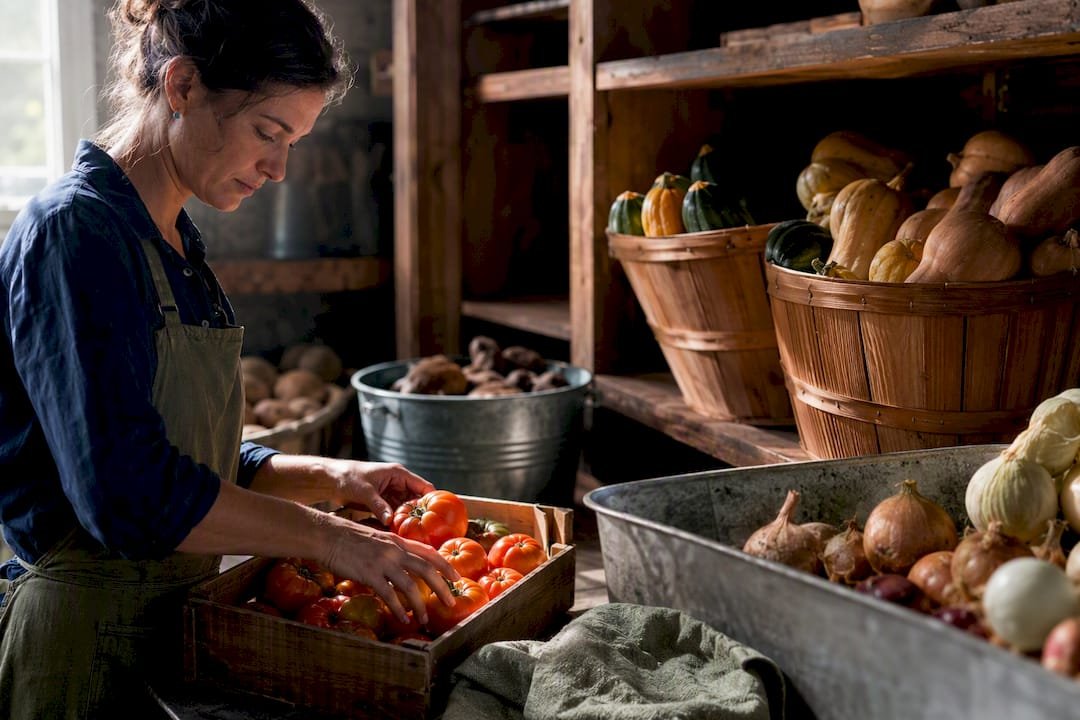
Outside the growing season, “local” often means one of three things: greenhouse production (energy-intensive but genuinely fresh), storage crops like squash, potatoes, and onions that keep well for months, or nothing at all, meaning your only real local option temporarily disappears from the shelf. This is where a lot of the local food advantage quietly evaporates for shoppers in colder growing regions for a good chunk of the year.
The practical fix is building your buying pattern around the calendar rather than the label. Lean hard into local for berries, corn, tomatoes, and leafy greens in peak season, when the freshness gap between local and shipped is largest and most noticeable in both taste and nutrition. Shift toward storage crops, frozen organic, or conventional imports during the off-season rather than paying a premium for “local” produce that had to travel further to reach you than the imported version did. Seasonal eating isn’t just a flavour preference; it’s the condition under which local food’s advantages actually hold up.
How restaurants apply the organic vs local trade-off
Foodservice operators make this decision every single day, usually without customers noticing. Local sourcing tends to win for perishables where freshness drives flavour: produce, herbs, dairy. Certified or verified low-spray inputs matter more for a narrower set of high-residue ingredients where the sourcing team wants documented assurance, not just proximity.
That’s a local-first approach applied at the scale of a working kitchen, not a marketing slogan.
If you’re eating out and care about sourcing, ask. A kitchen that presses its own tortillas or braises its own carnitas usually has a story worth hearing.
Editorial perspective: the false choice nobody warned you about
The organic-versus-local debate gets framed as a rivalry, and that framing is the problem. It’s not a rivalry. It’s two different questions wearing the same grocery aisle.
Organic answers “what was sprayed on this?” Local answers “how far did this travel, and who grew it?” Treating them as competing options forces people into a choice that doesn’t need to exist, and it usually pushes shoppers toward whichever label feels more virtuous rather than whichever one actually addresses their real concern. If pesticide exposure keeps you up at night, local produce sprayed with conventional chemicals does nothing to fix that, no matter how good the farmers market smells. If you care about your grocery dollars propping up a regional economy, organic strawberries flown in from another hemisphere don’t help with that either, no matter how clean the label looks.
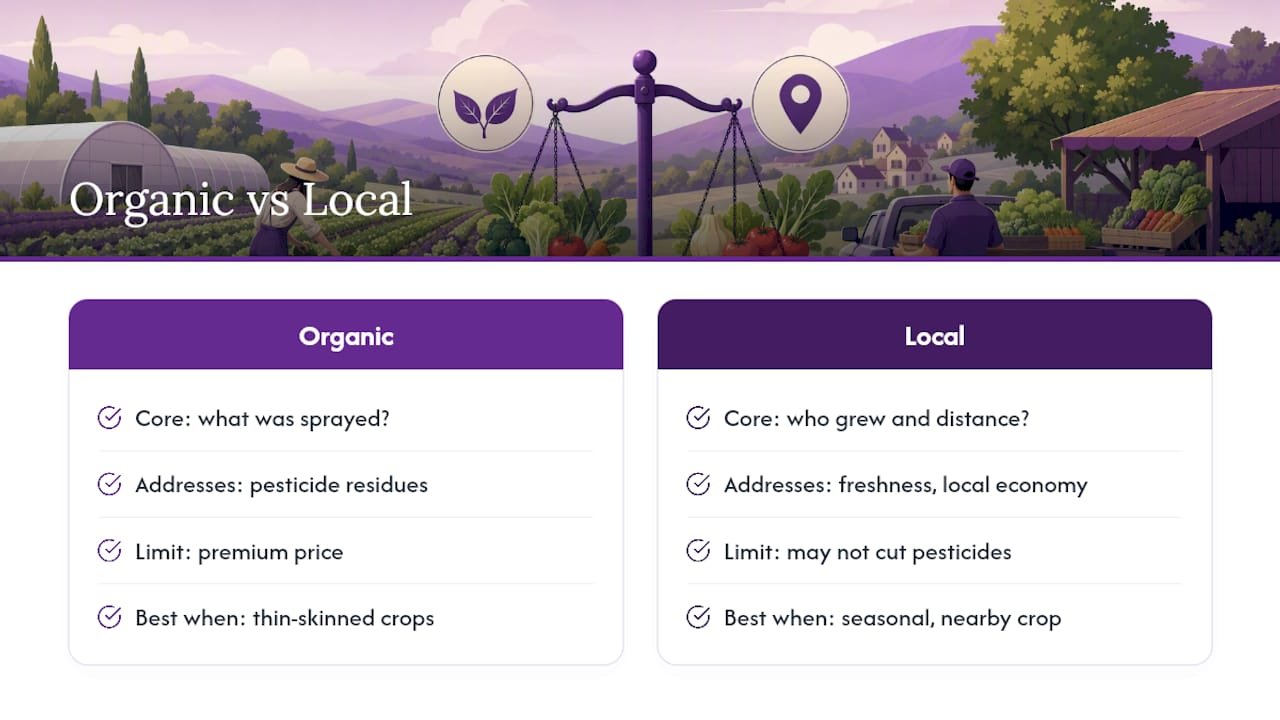
What gets underestimated constantly is how much the crop itself should drive the decision, more than either label in isolation. A thick-skinned avocado doesn’t need the organic premium. A bag of spinach probably does. A greenhouse tomato in January isn’t giving you the local freshness advantage you’re paying extra for, no matter what the sign says. The systematic reviews back this up: the residue difference between organic and conventional is real and measurable, but it varies enormously by crop, and the long-term health payoff is still far from settled science.
My honest read: stop looking for one label to do all the work. Ask what you’re actually trying to solve, pesticide exposure, freshness, carbon footprint, or keeping a farmer down the road in business, and let that answer drive the purchase, crop by crop, season by season.
— Austin
Try local, from-scratch Mexican food built on the same principle
If this whole comparison has you thinking about where your next meal is actually coming from, consider a local-first approach featuring house-pressed tortillas, regionally raised meats, and a from-scratch kitchen without deep frying. Browse the full menu to see how that plays out in burritos, bowls, tacos, and quesadillas, or check out catering options if you’re feeding a group and want the same sourcing standard applied to a bigger order.
Sources
- Canadian Food Inspection Agency — organic product standards
- A systematic review of organic vs conventional food consumption and health outcomes
- Mayo Clinic — organic foods: are they safer? more nutritious?
- Green America — is organic or local food better?
- CollectiveCrop — local food vs organic: which matters more?
FAQ
Is local food the same as organic food?
No. Local refers to how close food was grown or produced, with no consistent legal definition, while organic is a regulated production standard verified through the Canadian Food Inspection Agency’s certification rules. A product can be one, both, or neither.
Is organic really better than regular food?
For pesticide exposure, yes, organic produce shows consistently lower residue levels in the systematic review of organic versus conventional consumption. For nutrient content and long-term health outcomes, the evidence is mixed and doesn’t support a blanket claim that organic is nutritionally superior across the board.
Are there downsides to buying organic?
Cost is the main one, organic produce typically carries a price premium, and distance is another: certified organic products can travel just as far as conventional ones, so buying organic doesn’t guarantee freshness or local economic support. Budget strategies like buying seasonal, choosing frozen organic, or joining a CSA can offset the price gap, according to Mayo Clinic’s organic food guidance.
Are organic vegetables still sprayed?
Organic farming allows certain approved natural pesticides, so “organic” doesn’t mean zero spray, it means no synthetic pesticides under the certified standard. Residue levels are measurably lower than conventional produce, but not necessarily zero.