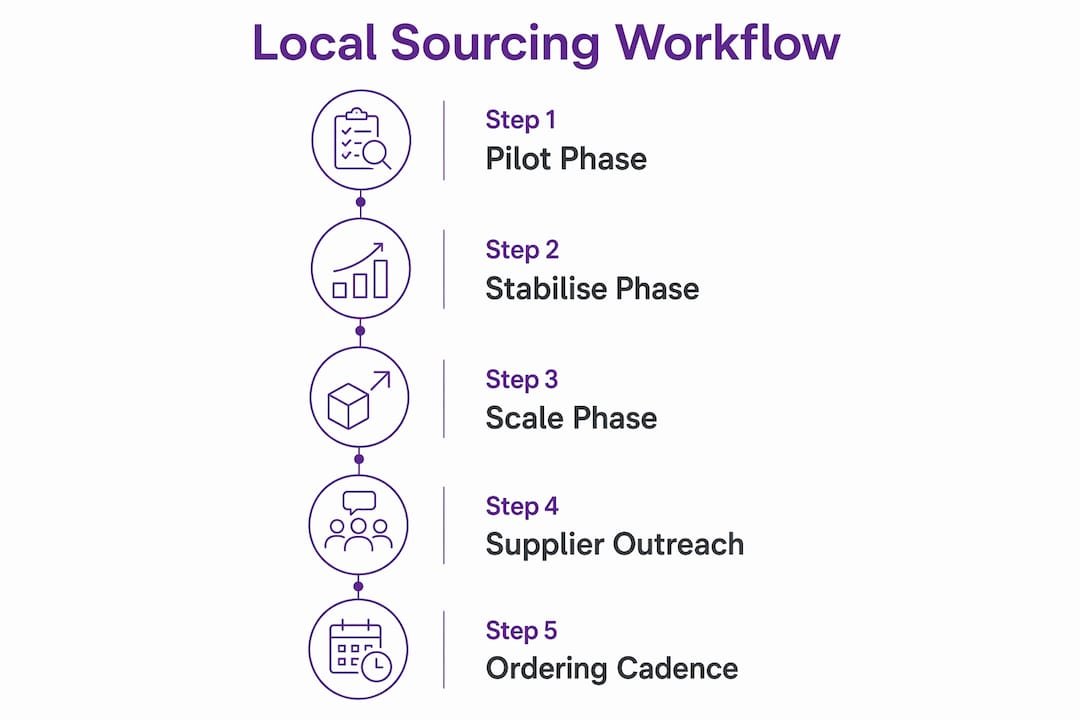
A local sourcing workflow for restaurants is the operational system that moves ingredients from regional producers into your kitchen reliably, at the right cost, and with enough redundancy that one missed delivery does not derail service. Done well, it cuts spoilage, sharpens your menu story, and makes your supply chain genuinely harder to disrupt.
Here is the core workflow at a glance:
- Audit your menu for high-impact SKUs (proteins, produce, dairy) and rank by spend and guest visibility
- Prioritise three to five hero items to pilot first rather than converting everything at once
- Find suppliers through farmers markets, provincial food hubs,
- Agriculture and Agri-Food Canada directories
- Run pilot orders for four weeks, tracking quality, yield, and lead time against your baseline
- Onboard and set cadence with standing weekly orders, substitution rules, and consolidated invoicing
- Measure KPIs monthly: percentage of local spend, fill rate, cost variance, and food waste
- Scale by adding SKU categories once the pilot phase is stable
Burritosplendido built its entire Manitoba operation around this logic, and the sections below walk through each step in enough detail that you can run your own pilot starting this week.
Table of Contents
- What does “local sourcing” actually mean for your restaurant?
- Why local sourcing pays off operationally and commercially
- What are the real operational challenges and how do you handle them?
- How to run your local sourcing workflow step by step
- Where do you find Canadian local suppliers?
- How do you onboard suppliers and manage ordering logistics?
- Which KPIs should you track to measure local sourcing progress?
- How Burritosplendido runs its Manitoba-first sourcing programme
- Copy-ready templates and checklists
- Key takeaways
- What running a local sourcing programme actually feels like
- Useful sources for Canadian restaurant operators
What does “local sourcing” actually mean for your restaurant?
The term gets used loosely, so pin it down before you write a policy. Most working definitions fall into one of three categories: distance-based, spend-based, or category-based.
Distance-based is the most common. The standard range sits at 50–150 km from your kitchen, though some programmes extend to 300 km when a specific product (say, a regional cheese or heritage grain) is worth the extra radius. The 100-mile (roughly 160 km) radius popularised by the locavore movement is a practical ceiling for most Canadian urban kitchens.
Spend-based targets are easier to audit because your accounting system already tracks dollars. A realistic pilot target is a small portion of total food spend sourced locally, scaling toward a larger portion by month twelve. These percentages are defensible to guests and grant reviewers alike.
Category-based programmes skip the geography debate and simply commit to local sourcing for specific product categories: all proteins, all fresh produce, or all dairy. This works well when your menu has a clear hero category and you want a clean marketing claim.
| Standard type | Best for | Trade-off |
|---|---|---|
| Distance (50–150 km) | Transparency and guest storytelling | Hard to verify without supplier documentation |
| Spend percentage (10–40%) | Finance tracking and grant reporting | Does not capture volume or menu prominence |
| Category-based | Strong marketing claims on hero items | Leaves commodity items unaddressed |
Pro Tip: Set targets in three phases: pilot (weeks 1–4), six-month, and twelve-month. Write each target into your operations manual with a measurement method beside it. Grant applications from programmes like the Canadian Agricultural Partnership often require documented targets and evidence of progress, so building the paper trail from day one saves significant work later.
A one-paragraph policy template you can adapt:
Why local sourcing pays off operationally and commercially
The freshness argument is real and measurable. Traditional produce can spend 7–10 days in transit before it reaches a restaurant kitchen. Cutting that to a same-day or next-day delivery window means your greens arrive with more of their usable life ahead of them, your proteins have a tighter cold-chain history, and your kitchen team spends less time trimming and discarding.
Operational benefits:
- Longer usable shelf life on produce and proteins, which directly reduces your weekly waste tonnage
- Faster provenance answers when a food-safety question arises (you call one farmer, not a distributor’s call centre)
- More flexibility to adjust order quantities based on actual reservation counts rather than guessing weeks out
- Shorter cold chains mean fewer temperature-abuse events during transport
Commercial benefits:
- Menu differentiation: specialty varieties and heritage breeds that broadline distributors simply do not carry
- A credible local story that supports premium pricing on hero items
- Community goodwill that translates into repeat visits and word-of-mouth
The pricing reality deserves a straight look. Pasture-raised eggs run roughly $4–6/dozen locally versus $1.50–2.50/dozen for commodity eggs. That gap is real. The offset comes from reduced spoilage, the ability to feature the item prominently on the menu at a price that reflects its provenance, and the elimination of at least one distributor markup. A single egg dish repositioned as a “Manitoba farm egg” feature can absorb that cost difference and then some, depending on your price point.
Treating farms as partners rather than vendors also improves reliability over time. Producers who feel economically respected tend to prioritise your orders when supply is tight, which is exactly when you need them most.
What are the real operational challenges and how do you handle them?
Seasonality is the one that catches most kitchens off guard. Manitoba’s growing season runs roughly May through October, which means your local tomato programme disappears in November. The mitigation is menu design: build seasonal dishes that celebrate what is abundant now, and use preservation techniques (pickling, freezing, curing) to carry flavours into the shoulder months. Burritosplendido’s Manitoba Whitefish/Pickerel tacos are a direct example of this thinking in practice.
Here is a quick vulnerability assessment checklist for each product category:
- What months is this item available locally?
- Do we have at least two local suppliers for it?
- What is our fallback if both local sources fail in the same week?
- Can we preserve or substitute this item without changing the guest experience?
- What is the cost difference between local and broadline fallback?
The redundancy rule is non-negotiable. Build at least two sources for every critical item. This does not mean two farms of identical scale; it means one primary and one backup you have already vetted, ordered from at least once, and have a contact for. A single-source local programme is more fragile than your current broadline arrangement.
Pro Tip: The coordination trap is real. Once you have more than four or five local suppliers, managing orders by phone and spreadsheet becomes a part-time job. Introduce a centralised ordering platform early, before the volume forces you to. Platforms that consolidate ordering, supplier discovery, and invoice matching make direct buying viable at scale and prevent the back-office from becoming the bottleneck.
Additional mitigation tactics by challenge:
- Variable yields: Keep a two-week rolling forecast shared with your suppliers so they can plan harvests. Buffer inventory (one extra case of a critical item) costs less than a mid-service shortage.
- Cost volatility: Lock in seasonal pricing during peak harvest when supply is highest and negotiate a fixed rate for a defined volume window.
- Invoicing overhead: Require all suppliers to use a single invoice format and set a weekly consolidated payment run. Supply chain disruptions are easier to manage when your paperwork is already tidy.
- Logistics complexity: Batch deliveries to two or three days per week rather than accepting daily drops from every supplier separately.
How to run your local sourcing workflow step by step
The pilot phase is four weeks. The goal is not perfection; it is data.
Pilot phase (weeks 1–4)
| Task | Owner | Output |
|---|---|---|
| Audit menu for top 10 SKUs by spend | GM / Procurement lead | Ranked SKU list with current cost and supplier |
| Select 3 hero SKUs for pilot | GM + Kitchen lead | Pilot SKU shortlist |
| Run baseline costing on each SKU | Finance | Cost-per-unit baseline sheet |
| Identify 2 candidate suppliers per SKU | Procurement lead | Supplier longlist |
| Place trial orders (minimum 2 per SKU) | Procurement lead | Trial order log |
| Collect quality and yield feedback | Kitchen lead | Weekly feedback form |
Roles and responsibilities
- Procurement owner: supplier outreach, order placement, invoice reconciliation, KPI tracking
- Kitchen lead: quality assessment, yield feedback, menu adaptation input
- Receiving staff: QC at delivery, variance logging, temperature checks
- Finance: cost variance tracking, payment runs, grant documentation
Supplier outreach email template
Ordering cadence
Standing orders go out every [Tuesday] for [Thursday] delivery. Emergency replenishment requests require 48 hours’ notice minimum and are reserved for genuine shortages, not planning gaps. Ad-hoc orders above the standing quantity need kitchen lead sign-off before the procurement owner places them.
Stabilise phase (months 2–3)
| Milestone | Owner | Target |
|---|---|---|
| Confirm standing orders with pilot suppliers | Procurement lead | Signed order agreements in place |
| Add 2 additional SKU categories | GM + Kitchen lead | Category expansion plan |
| First KPI review against baseline | GM + Finance | Monthly dashboard completed |
| Introduce consolidated weekly invoice run | Finance | Single payment batch per week |
Scale phase (months 4–12)
| Milestone | Owner | Target |
|---|---|---|
| Reach local spend target (e.g., 20% of food spend) | GM | Monthly KPI report |
| Onboard backup supplier for each hero SKU | Procurement lead | Two sources confirmed per SKU |
| Seasonal menu update tied to local availability | Kitchen lead | Updated menu with local callouts |
| Annual supplier review and contract renewal | GM + Procurement lead | Supplier scorecards completed |
Transitioning from pilot to standing orders without disrupting the kitchen comes down to one rule: do not cut your broadline order for a given SKU until the local supplier has delivered reliably for at least four consecutive weeks. Run both in parallel briefly, then taper the broadline volume as confidence builds.
Where do you find Canadian local suppliers?
Discovery is the step most managers underestimate. The channels below are all active in Canada and cover different parts of the supplier landscape.
Discovery channels:
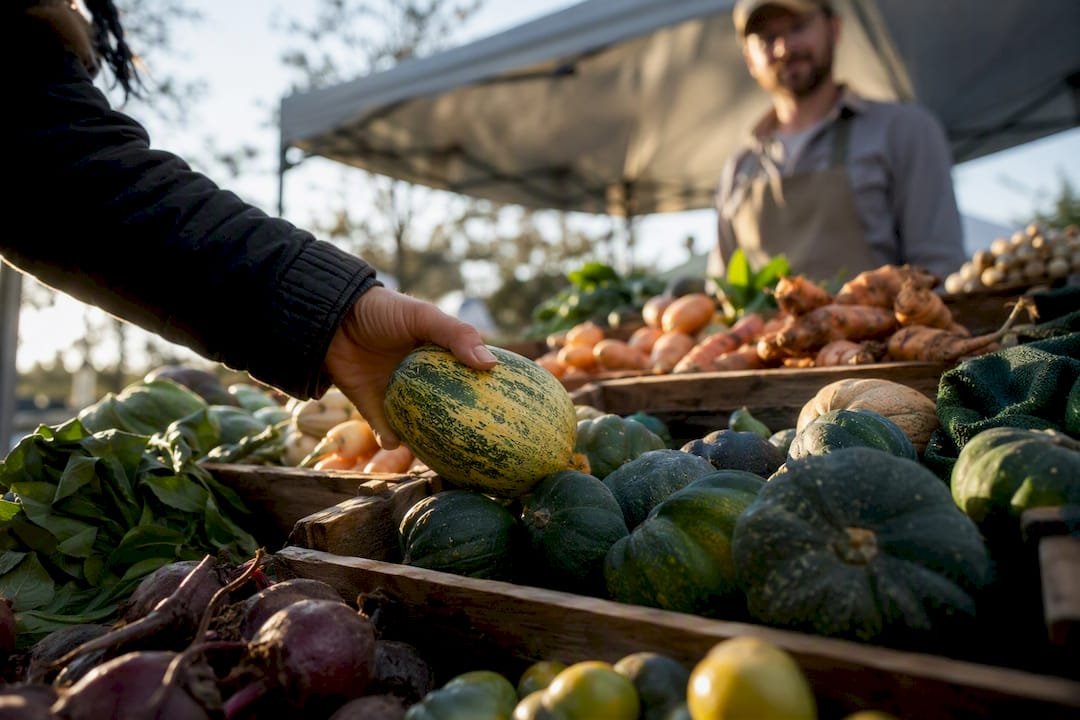
- Farmers markets: The fastest way to meet producers face-to-face, sample products, and assess whether a farmer understands food-service volumes. Markets in Winnipeg (The Forks Market, St. Norbert Farmers’ Market), Calgary (Calgary Farmers’ Market), and Vancouver (Trout Lake Farmers Market) all have vendors who supply restaurants.
- Provincial agricultural extension offices: Manitoba Agriculture, Ontario’s Foodland Ontario programme, and BC’s Investment Agriculture Foundation all maintain producer directories and can connect you with regional specialists.
- Regional food hubs: Food hubs aggregate products from multiple farms into a single order and delivery, which solves the “too many small invoices” problem immediately. Manitoba has the Neechi Commons co-op model; Ontario has Local Food Plus and the Ontario Natural Food Co-op network.
- Agriculture and Agri-Food Canada: The federal Buy Canadian directory and the Canadian Food Inspection Agency’s producer registry are starting points for verified producers.
- Chef networks: Culinary federations and chef associations in each province maintain informal supplier referral networks. A single conversation with a peer chef can surface three suppliers you would not find online.
- Local Line: A Canadian-built farm-to-fork procurement platform that connects restaurants directly with regional producers and handles ordering, invoicing, and supplier onboarding in one place.
Supplier evaluation questions to ask before your first order:
- What is your minimum order quantity and how much notice do you need?
- Which days can you deliver, and do you deliver directly or use a third party?
- What certifications do you hold (organic, GAP, HACCP, etc.)?
- How do you handle a short crop or a week when you cannot fill the order?
- Can you provide traceability documentation on request?
- What are your payment terms and preferred invoice format?
Pro Tip: Use a food hub as your entry point if you have fewer than three local suppliers confirmed. The hub handles aggregation, invoicing, and often cold-chain logistics, so you get the local sourcing benefit without the coordination overhead. Once you know which individual farms produce your best-performing items, you can build direct relationships alongside the hub rather than replacing it.
When to go direct versus using a hub: direct farm relationships make sense for hero SKUs where provenance is a marketing asset and volume is predictable. Hubs make sense for commodity-adjacent items (mixed greens, root vegetables, eggs) where you want local origin but do not need a specific farm’s name on the menu.
How do you onboard suppliers and manage ordering logistics?
Onboarding a new local supplier takes more upfront work than adding a SKU to a broadline order, but a single digital onboarding flow captures all required documents and cuts the back-and-forth dramatically. Build a checklist and send it before the first order.
Supplier onboarding checklist:
- Certificate of Insurance (COI) naming your restaurant as additional insured
- Product specifications sheet (weight, pack size, grade, handling requirements)
- Food safety certification or equivalent documentation
- Delivery window confirmation (days, times, vehicle type)
- Primary contact and after-hours escalation contact
- Payment terms agreed in writing (net 7, net 14, or on delivery)
- Substitution rules: what happens if the ordered item is unavailable?
Sample contract headlines to include in a written agreement:
- Minimum order quantity and lead time requirements
- Quality standards with specific rejection criteria (e.g., temperature on arrival, visual grade)
- Substitution policy: supplier must notify by [time] the day before delivery
- Payment timing and late-payment terms
- Liability for perishables rejected at receiving (credit or replacement within 48 hours)
- Termination notice period (30 days is standard for small producers)
Receiving and QC checklist for front-line staff:
- Check delivery temperature on arrival (proteins: below 4°C; frozen: below -18°C)
- Verify item count and weight against the purchase order
- Inspect for visible defects, damage, or off-odours
- Log any variance on the receiving sheet with supplier name, date, and description
- Sign the delivery receipt only after the check is complete
- Escalate rejections to the procurement owner within one hour
Pro Tip: Set a single weekly invoice consolidation day. Ask all local suppliers to submit invoices by [Wednesday noon] for a [Friday] payment run. This one change eliminates the daily invoice triage that makes multi-supplier programmes feel unmanageable.
Ordering cadence template: standing orders confirmed by Tuesday for Thursday delivery; two-week rolling forecast shared with suppliers every other Monday; emergency replenishment requests accepted up to 48 hours before the next delivery window. Finance receives a consolidated invoice summary every Friday morning.

Which KPIs should you track to measure local sourcing progress?
Six metrics cover the full picture without creating a reporting burden.
KPI list with formulas:
- % local spend: (Local supplier spend ÷ Total food spend) × 100. Pull from your accounting system monthly.
- Fill rate for hero SKUs: (Units received ÷ Units ordered) × 100. Track per supplier per week.
- Cost variance vs baseline: (Current unit cost − Baseline unit cost) ÷ Baseline unit cost × 100. Review monthly.
- Food waste change: Kilograms of waste per week, tracked against your pre-pilot baseline. Weigh and log at each shift.
- Supplier lead time average: Average days between order placement and delivery, per supplier. Log on each purchase order.
- Supplier on-time percentage: (On-time deliveries ÷ Total deliveries) × 100. Flag any supplier below 85%.
Data sources and collection frequency:
| KPI | Data source | Frequency |
|---|---|---|
| % local spend | Accounting / POS | Monthly |
| Fill rate | Receiving log | Weekly |
| Cost variance | Purchase orders vs baseline sheet | Monthly |
| Food waste (kg/week) | Kitchen waste log | Weekly |
| Supplier lead time | Purchase order timestamps | Per order |
| Supplier on-time % | Receiving log | Monthly |
Target ranges by phase:
- Pilot (weeks 1–4): % local spend 5–10%; fill rate above 80%; cost variance within ±15% of baseline
- Stabilise (months 2–3): % local spend 15–20%; fill rate above 90%; cost variance within ±10%
- Scale (months 4–12): % local spend 25–40%; fill rate above 93%; cost variance within ±8%
Start by tracing one real order through the systems you already use before adding new tools. Build your KPI dashboard around the minimum data fields that drive your weekly decisions, then expand as the programme matures.
How Burritosplendido runs its Manitoba-first sourcing programme
Burritosplendido launched in Winnipeg in November 2012 with a clear operational thesis: source Manitoba first, then look further afield only when the province cannot supply what the kitchen needs. That constraint turned out to be a creative forcing function rather than a limitation.
The hero SKUs that anchored the programme were flour, pork, poultry, cheese, and fresh produce. Manitoba-milled flour goes into every house-pressed tortilla. Pork for Carnitas comes from local farms. Poultry is sourced through Granny’s Chicken, a Manitoba producer. Cheese comes from Bothwell Cheese, a well-established Manitoba dairy. Fresh produce flows primarily through Peak of the Market, a Manitoba grower-owned cooperative that has supplied the province’s food service sector for decades.
Operational adaptations that made the programme work:
- Menu inserts and digital menu callouts naming each supplier, which turned provenance into a guest-facing story rather than a back-of-house detail
- Staff training on each supplier’s story so front-line team members could answer guest questions confidently
- Receiving cadence adjusted to match Peak of the Market’s delivery schedule rather than forcing the supplier to conform to a standard broadline window
- Reconciliation process centralised under one procurement owner per location to prevent invoice duplication across the multi-location network
Lessons learned:
- Start with the items that appear on the most menu items, not the most expensive ones. Flour and produce touch everything; converting them first creates the broadest impact.
- Defer complex logistics (multiple small farms, daily deliveries) until the programme is stable. Use a cooperative or hub first.
- Centralise procurement decisions as soon as you open a second location. Decentralised buying at scale creates price inconsistency and supplier confusion.
- Schedule farm visits at least twice a year. The relationship quality that comes from standing in a field with your supplier is not replicable by email.
Pro Tip: If you are applying for provincial or federal food-system grants (Canadian Agricultural Partnership, Manitoba’s Grow Forward programme), document your supplier relationships with signed agreements and purchase records from day one. Retroactive documentation is painful and often incomplete.
For readers interested in how Burritosplendido brings local Manitoba ingredients to the menu, the brand’s farm-to-fork story is worth reading alongside this workflow.
Copy-ready templates and checklists
Supplier scorecard
| Evaluation field | Scoring criteria | Score (1–5) |
|---|---|---|
| Price vs market | Competitive within ±15% of baseline | |
| Quality consistency | Meets spec on most deliveries | |
| Lead time | Delivers within agreed window | |
| Reliability (fill rate) | Fills 90%+ of standing order | |
| Documentation | COI, specs, and invoices always current | |
| Communication | Responds to queries within 4 hours |
Review scorecards quarterly. Any supplier scoring below 3 on two consecutive reviews gets a formal improvement conversation before the next contract renewal.
Sample outreach email
Receiving checklist (front-line staff)
- Temperature check on arrival (proteins below 4°C, frozen below -18°C)
- Count and weigh against purchase order
- Visual inspection: no damage, discolouration, or off-odours
- Log any variance: supplier, date, item, quantity short or rejected
- Sign delivery receipt only after full check
- Notify procurement owner of any rejection within one hour
Standing order template (weekly cadence)
- Confirm standing quantities with kitchen lead every Monday by noon
- Submit order to supplier by Tuesday 3 PM for Thursday delivery
- Share two-week rolling forecast with supplier every other Monday
- Log confirmed order in the purchase order system with expected delivery date
- Receive and QC on Thursday; log variances by end of shift
- Submit invoice to finance by Friday noon for weekly payment run
Adapting for multi-location operations: assign one procurement owner per region rather than per location. That person manages all supplier relationships and consolidates orders across locations before submitting. Each location’s kitchen lead submits their weekly quantities to the regional procurement owner by Monday morning. This prevents suppliers from receiving three separate small orders from the same brand on the same day.
For ethical sourcing principles that underpin fair supplier agreements, the framework from Spaceman is a useful reference when drafting your contract terms.
Key takeaways
A well-run local sourcing workflow delivers fresher ingredients, lower spoilage, and a more resilient supply chain when you build it on redundant supplier relationships, clear KPIs, and a phased rollout that starts with three hero SKUs and scales from there.
| Point | Details |
|---|---|
| Start with three hero SKUs | Pilot on your highest-spend, highest-visibility items before expanding to other categories. |
| Build two sources per critical item | A single local supplier per SKU is more fragile than your current broadline setup. |
| Set phased spend targets | Aim for 5–10% local spend in the pilot, reaching 15–20% by months two to three, and scaling toward 25–40% by month twelve. |
| Track six KPIs monthly | % local spend, fill rate, cost variance, waste, lead time, and on-time delivery cover the full picture. |
| Centralise invoicing early | A weekly consolidated payment run prevents multi-supplier admin from becoming a part-time job. |
Week 1: Audit your top ten SKUs by spend and identify three hero items for the pilot.
Month 1: Place trial orders with at least two suppliers per hero SKU and collect quality and yield data.
Months 2–3: Confirm standing orders, add two new SKU categories, and run your first KPI review.
By month 12: Reach your local spend target, complete annual supplier scorecards, and update your seasonal menu.
Expect cost variance of ±15% in the pilot phase as you calibrate volumes and negotiate pricing. Staff time for procurement management typically runs two to four hours per week for a single-location operation in the stabilise phase. Supply volatility is highest in the first shoulder season; having backup suppliers confirmed before that window is the single most important preparation you can make.
The Burritosplendido Manitoba-first programme above shows what this looks like in practice across a multi-location fast-casual operation.
What running a local sourcing programme actually feels like
The thing that surprises most operators is how much of this work is relationship management, not procurement. You spend more time on the phone with a farmer discussing next week’s harvest than you do comparing prices on a spreadsheet. That is not a complaint; it is just a different skill set than managing a broadline account, and it takes a few months to feel natural.
The step that consumes the most time in the first year is not finding suppliers. It is getting your own internal systems ready to handle multiple invoices, variable quantities, and delivery windows that do not align with your existing schedule. Centralise invoicing before you onboard your third supplier, not after.
What pays off fastest is the menu story. Within weeks of naming a supplier on your menu or training your staff to talk about where the pork comes from, you will notice guests asking about it. That conversation is worth more in repeat visits and social sharing than most paid marketing.
Practical lessons:
- Schedule farm visits in April and September, before and after the main growing season, so you understand what is coming and what is winding down
- Centralise invoicing and purchase orders from day one, even if it feels like overkill for two suppliers
- Do not wait for the perfect supplier; start with the best available and improve the relationship over time
- Build your seasonal menu changes around your supplier’s harvest calendar, not the other way around
- Keep your broadline distributor relationship intact as a safety net, especially through the first winter
Pro Tip: The most common rollout mistake is converting too many SKUs too fast. Operators who pilot three items and stabilise them before expanding consistently outperform those who try to go 30% local in month one. Slow the front end down and the back end takes care of itself.
Useful sources for Canadian restaurant operators
A short annotated list of the most useful resources for discovery, onboarding, and technology:
For supplier discovery:
- Agriculture and Agri-Food Canada: Federal producer directories, the Buy Canadian programme, and regional food-system contacts. Start here for verified producer lists by province.
- CollectiveCrop guide to farm sourcing: Practical step-by-step guidance on auditing SKUs, finding suppliers, and building redundant networks.
- The Prep: how local sourcing pays off: Operator-level perspective on relationship-building with producers.
For onboarding and technology:
- Local Line (buyers): Canadian-built platform for direct farm-to-restaurant ordering, supplier onboarding, and invoice management.
- Ubisar workflow planning: Framework for building harvest and production planning workflows that connect only the data fields you actually need.
For supply chain resilience:
- Restaurant Tech News: hyper-local sourcing: Analysis of how shorter supply chains reduce exposure to global logistics shocks.
For Burritosplendido catering and supplier partnerships:
Burritosplendido’s catering programme is built on the same Manitoba-first sourcing principles described in this guide. If you are planning an event or exploring supplier partnership opportunities, the catering page is the right starting point.