Most Canadians picture a burrito as an overstuffed, foil-wrapped cylinder packed with rice, beans, cheese, sour cream, guacamole, and whatever else fits. That image is understandable, because it is what most fast-casual chains across Canada serve. But the real Mexican burrito looks almost nothing like that. Authentic versions from northern Mexico are lean, focused, and built around a single beautiful filling. Once you understand the difference, you will never look at a burrito the same way again.
Table of Contents
- What makes a burrito authentically Mexican?
- Classic types of Mexican burritos by region
- Comparing Mexican burritos to North American styles
- Tips for enjoying or preparing authentic burritos in Canada
- What Canadians can learn from authentic Mexican burritos
- Explore authentic burrito flavours in Canada with Burrito Splendido
- Frequently asked questions
Key Takeaways
| Point | Details |
|---|---|
| Authentic roots | Mexican burritos started in northern regions with thin tortillas and a single stewed filling. |
| Regional varieties | Sonora, Chihuahua, and other states offer classic burrito styles with unique ingredients. |
| Contrast with North America | Mexican burritos focus on quality and simplicity, while North American versions are bigger and filled with extras. |
| Home preparation | Canadian food lovers can make authentic burritos by using locally sourced ingredients and proper techniques. |
| Local flavour empowerment | Adopting Mexican authenticity can elevate Canadian burrito experiences both at home and in restaurants. |
What makes a burrito authentically Mexican?
The word “burrito” translates loosely to “little donkey,” and the dish has genuine working-class roots. It was food for labourers: portable, filling, and built for efficiency. That origin story matters because it explains everything about how a true Mexican burrito is constructed.
Authentic Mexican burritos originate from northern Mexico, primarily Sonora and Chihuahua, using thin flour tortillas wrapped around a single guisado (stewed filling) like machaca, chilorio, or deshebrada, emphasising simplicity and portability for labourers. A guisado, by the way, is simply a slow-cooked stew or braised filling, one that builds deep flavour over time through low, steady heat.
The tortilla used in northern Mexico is equally important. It is called a tortilla de agua or a sobaquera, which is a thin, large, pliable wheat flour tortilla with a slightly charred surface. Northern Mexico developed a strong wheat culture because the climate suited grain farming, unlike the corn-dominant south. That difference in agriculture explains why flour tortillas belong in northern Mexican cooking rather than being an American invention.
Key markers of an authentic Mexican burrito include:
- A single, well-seasoned guisado filling rather than a stack of toppings
- A thin, supple flour tortilla pressed and cooked fresh
- No layer of rice or a mountain of beans weighing it down
- Flavour that comes from the cooking method, not the volume of ingredients
- Portability as a design principle, not an afterthought
“The beauty of a Mexican burrito is restraint. One great filling in a great tortilla is the entire point.”
Pro Tip: When evaluating a burrito’s authenticity, look at the tortilla first. If it is thick, puffy, or steamed rather than charred and thin, the approach is likely North American rather than regional Mexican.
Understanding what authentic Mexican food for Canadians actually involves helps reframe expectations before you ever take a bite. Authenticity is not about exclusion or snobbery. It is about understanding where flavours come from and why they work.
Classic types of Mexican burritos by region
With authenticity in mind, let us explore the most iconic types of Mexican burritos by region. Each one reflects the land, climate, and culinary tradition of the place that created it.
Burrito de guisado
This is the everyday burrito of northern Mexico. Thin flour tortillas are filled with one stew-like guisado such as chicharron in salsa roja, shredded chicken in chile verde, or rajas con crema. Chicharron in salsa roja is braised pork skin simmered in a tomato and dried-chile sauce until tender. Rajas con crema is strips of roasted poblano pepper folded into cream. These are not complicated dishes, but their depth of flavour is extraordinary because of the slow, careful cooking involved.
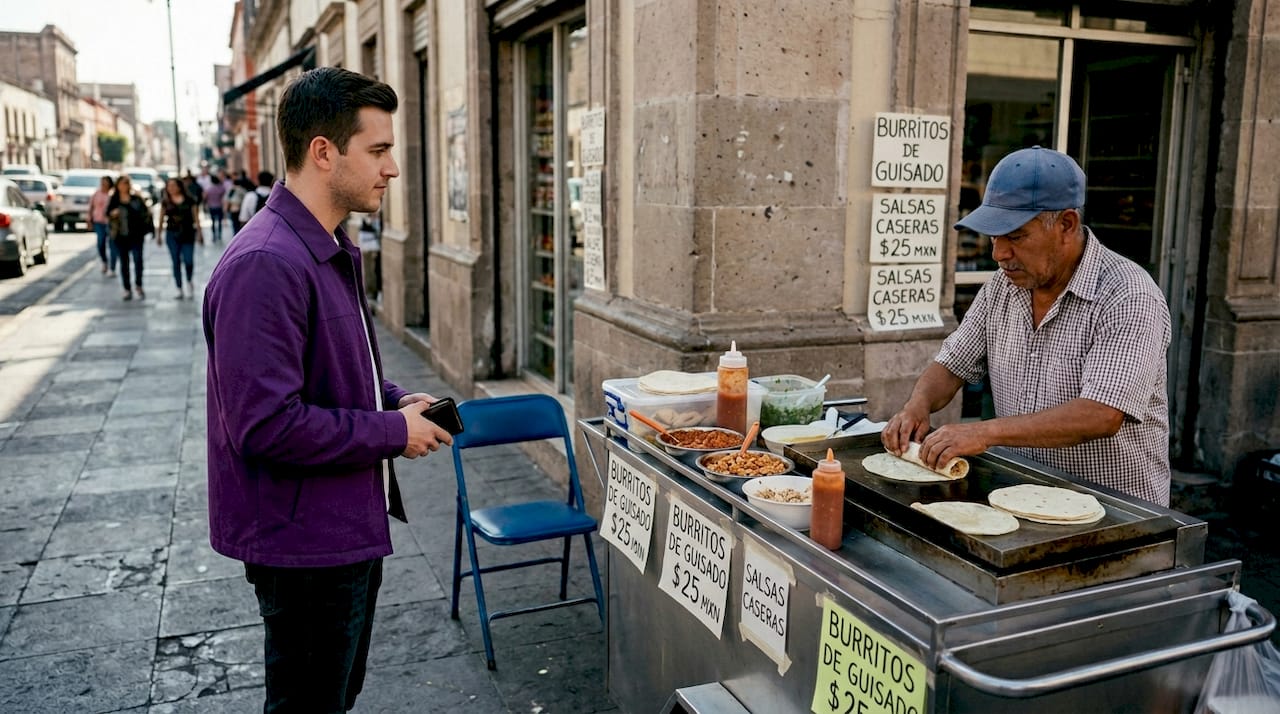
The burrito de guisado is the foundation for understanding all other varieties. It teaches you that simplicity is a skill, not a shortcut.
Burrito de chile relleno (Chihuahua style)
This Chihuahua specialty wraps a flour tortilla around a fried, cheese-stuffed roasted chile such as an Anaheim or güero pepper, sometimes accompanied by refried beans and salsa. The chile relleno (meaning “stuffed chile”) is first roasted to loosen the skin, then peeled, filled with cheese, battered, and pan-fried until golden.
Wrapping that in a tortilla creates a satisfying contrast of textures: soft tortilla, crispy battered chile, and melted cheese inside. It is an indulgent regional speciality that feels nothing like the loaded North American burrito, yet delivers enormous satisfaction.
Burro percherón (Sonora style)
Sonora produces arguably the most impressive of the regional varieties. The burro percherón is a giant burrito, up to 20 inches long, filled with carne asada, tomatoes, avocado, and queso Chihuahua. Carne asada is beef that has been marinated and grilled over high heat, producing charred edges and juicy, flavourful meat. Queso Chihuahua is a mild, creamy melting cheese named after the state where it originated.
What makes the burro percherón remarkable is not its size alone. It is that even at that scale, the filling remains focused. You are not getting 12 ingredients. You are getting a few exceptional ones, prepared with skill.
| Burrito type | Region | Key filling | Tortilla style |
|---|---|---|---|
| Burrito de guisado | Northern Mexico | Single slow-cooked stew | Thin flour, charred |
| Burrito de chile relleno | Chihuahua | Fried stuffed roasted chile | Thin flour |
| Burro percherón | Sonora | Carne asada, avocado, queso | Large, thin flour |
| Burrito de machaca | Sonora/Chihuahua | Dried shredded beef, egg, chile | Thin flour |
| Burrito de frijoles | Throughout the north | Refried beans, chile | Thin flour |
Common regional fillings you will encounter include:
- Machaca: Dried, shredded beef rehydrated with tomato, onion, and pepper
- Chilorio: Pulled pork braised in chile colorado sauce, a Sinaloan favourite
- Deshebrada: Shredded beef cooked with tomatoes and dried chiles
- Frijoles de olla: Pot beans cooked from scratch, deeply flavourful
Pro Tip: If you want to practise making authentic burritos in Canada, start with a machaca-style filling using Canadian beef, dried chiles from a Latin grocery, and fresh tomatoes. The ingredients are accessible, and the technique teaches you the core principle of patience in cooking.
Understanding Mexican tortilla essentials is just as important as choosing the right filling. A good tortilla presses thin, cooks quickly on a hot comal (a flat griddle), and develops those characteristic brown spots that signal flavour and proper heat.
Comparing Mexican burritos to North American styles
Having explored the regional classics, let us see how these differ from what Canadians might expect in North American burritos.
Authentic preparation prioritises one high-quality guisado in a thin tortilla de agua or sobaquera. There is no rice or beans overload like you see in US styles, and no comparison to loaded “Mission” or “California” burritos.
“The Mission burrito, born in San Francisco’s Mission District in the 1960s, was designed for the American appetite: big, filling, and customisable. It solved a different problem than the original Mexican burrito did.”
Here is a direct comparison between the two approaches:
| Feature | Authentic Mexican burrito | North American burrito |
|---|---|---|
| Tortilla | Thin, charred flour tortilla | Thick, steamed, often much larger |
| Number of fillings | One guisado | Many (meat, rice, beans, cheese, etc.) |
| Rice included | Rarely or never | Almost always |
| Beans | Occasionally, as the sole filling | Frequently layered alongside other items |
| Portion philosophy | Portable meal, moderate size | Oversized, sit-down eating experience |
| Flavour source | Slow-cooked filling | Variety of separate components |
The four most important contrasts to keep in mind:
- Simplicity vs. abundance: Mexican burritos trust one great filling. North American ones stack flavours on top of each other, which can dilute the impact of each ingredient.
- Tortilla texture: A thin, freshly pressed tortilla becomes part of the flavour experience. A thick steamed one is primarily a delivery vehicle.
- Size and portability: Authentic burritos were designed to be eaten on the move. The Mission-style burrito requires both hands and a full meal’s worth of focus.
- Seasoning philosophy: In Mexican cooking, the guisado carries all the seasoning. In North American versions, salsa, sour cream, and other toppings do the heavy lifting.
Exploring best authentic burrito flavours means understanding this philosophy first. And if you are curious about how these ideas play out in real-world settings, looking at Mexican street food picks shows how street food culture supports the same values of simplicity and freshness.
Tips for enjoying or preparing authentic burritos in Canada
Now, for Canadian burrito lovers ready to go beyond the basics, here is how to enjoy or prepare authentic styles at home or locally.
Northern wheat culture enables large pliable tortillas, while guisados slow-cooked for deep flavour define the filling. There is also an interesting edge case: wet burritos, inspired by regional dishes like tortas ahogadas (sandwiches drowned in spicy tomato sauce), show how the form can evolve without abandoning its core values.
Here are practical steps for bringing authentic flavours into your Canadian kitchen:
- Source the right tortillas. Look for thin flour tortillas from Latin grocery stores, or press your own using Canadian all-purpose flour, salt, water, and a little lard or shortening. The texture should be soft and flexible, not thick or bready.
- Choose one great filling and commit to it. Pick carnitas (braised pork), barbacoa (slow-cooked shredded beef), or a vegetarian guisado like rajas con crema. Do not try to fit everything into one burrito.
- Use dried chiles for depth. Ancho, guajillo, and pasilla chiles are available in many Canadian grocery stores and Latin markets. Toast them briefly, rehydrate in hot water, then blend into a sauce for your braising liquid.
- Slow-cook everything. The difference between a good guisado and a great one is time. Give your filling two to three hours of low, steady heat. The connective tissue in meat breaks down, sauces thicken, and flavours meld into something genuinely complex.
- Warm your tortilla properly. Place it directly on a dry, hot cast-iron pan for 30 seconds per side until dark spots appear. This changes both the flavour and the texture dramatically.
Pro Tip: Exploring Canadian burrito ingredients reveals that many excellent substitutions are available right here. Manitoba pork, for example, is rich and well-suited to slow braising, making it ideal for carnitas-style preparations. Local produce from farmers’ markets can stand in beautifully for the fresh tomatoes and peppers used in traditional guisados.
One often-overlooked option is the wet burrito. Unlike the dry-rolled version, a wet burrito is smothered in a red or green chile sauce and sometimes melted cheese on top before serving. It requires a fork and plate, but the result is extraordinary: the tortilla softens into the sauce and becomes part of the flavour rather than just a wrapper.
What Canadians can learn from authentic Mexican burritos
There is a tendency in North American food culture to equate value with volume. Bigger portions feel more generous. More toppings feel more luxurious. But authentic Mexican burritos quietly argue the opposite case, and they make a convincing point.
When you eat a burrito de guisado from Sonora, every bite delivers the same flavour: consistent, deep, and satisfying. There is no hunting for the “good part” or biting into a pocket of plain rice. The filling is the experience from first bite to last, and that consistency is only possible because restraint shaped the recipe.
This is the lesson Canadian food culture can genuinely take from northern Mexico: quality of preparation outperforms quantity of ingredients, every single time. When you slow-cook a single protein with care, season it correctly, and wrap it in a fresh tortilla pressed that morning, you have done everything necessary. Nothing else is needed.
The regional stories behind each burrito variety also matter. The burro percherón reflects Sonora’s cattle culture. Machaca burritos reflect the ingenuity of preserving meat in a hot desert climate. Chilorio comes from Sinaloa’s tradition of cooking pork in deeply spiced sauces. Every variety carries a history, and eating it is a small act of connection to that history.
Canadian restaurants and home cooks who understand this philosophy tend to produce better food. The local ingredient stories that Burrito Splendido has built its reputation on reflect exactly this principle: knowing where your ingredients come from, treating them with care, and letting their quality do the work. Manitoba pork, Bothwell Cheese, and Granny’s Chicken all carry stories. Honouring those ingredients by not burying them under unnecessary additions is both a culinary and an ethical choice.
Explore authentic burrito flavours in Canada with Burrito Splendido
If reading about regional Mexican burritos has made you hungry for something more genuine than the average Canadian fast-food wrap, you are in good company.
Burrito Splendido was built on exactly this philosophy: slow-cooked proteins, fresh-pressed tortillas made with 100% Manitoba flour, and an honest commitment to quality over quantity. Whether you want to experience the difference firsthand at one of our Winnipeg and Brandon locations, or you are looking for inspiration on authentic burritos at home, we have the resources and the flavours to support that journey. We are also proud to offer Mexican catering options for events where great food matters. Visit us online and discover why burrito authenticity is worth caring about.
Frequently asked questions
What is the most authentic type of Mexican burrito?
The most authentic burritos are those from northern Mexico, using thin flour tortillas wrapped around a single slow-cooked filling such as machaca or chilorio, because authentic burritos originate in Sonora and Chihuahua where simplicity and portability were the design principles.
What ingredients are commonly used in traditional Mexican burritos?
Typical fillings include machaca, chilorio, deshebrada, chile relleno, carne asada, and regional guisados, because traditional fillings such as chicharron in salsa roja or rajas con crema are all single-ingredient stews wrapped in a thin flour tortilla.
How do Mexican burritos differ from North American ones?
Mexican burritos feature one filling and a thin charred tortilla, while North American versions rely on bulkier tortillas and many layered add-ons, because North American styles like Mission and California burritos were designed for different cultural expectations around portion size.
Can I make authentic Mexican burritos with Canadian ingredients?
Yes, you can use locally sourced meats and fresh vegetables, provided you prioritise slow-cooked fillings and press thin wheat tortillas, because slow cooking is the technique that transforms simple Canadian ingredients into genuinely complex and flavourful guisados.
Recommended
- How to make authentic burritos with Canadian ingredients – Burrito Splendido
- What ‘authentic’ Mexican food really means for Canadians – Burrito Splendido
- Craving Authentic Flavors? Why Burrito Splendido is the Top Choice for Mexican Food in Canada – Burrito Splendido
- Best paleo burrito options in Canada: a guide – Burrito Splendido
- Mexican Restaurant with Drive-Thru | PepperLot