Authenticity in catering is defined as the practice of delivering genuine, transparent culinary experiences grounded in verifiable ingredients, traditional preparation methods, and honest cultural representation. The role of authenticity in catering extends well beyond flavour. Research confirms that perceived brand authenticity significantly increases consumer trust, which then fully mediates its effect on loyalty in food-related contexts. For caterers and event organisers, this means authenticity is not a marketing label. It is the operational foundation that converts first-time guests into repeat clients. Burritosplendido, for example, has built its entire catering model around this principle through locally sourced Manitoba ingredients, from-scratch preparation, and transparent provenance storytelling.
What is the role of authenticity in catering for consumer trust?
Authenticity in catering operates through specific psychological pathways, not vague goodwill. A 2026 study published in Frontiers in Nutrition measured these pathways precisely: authenticity drives trust at β = 0.54, and trust drives loyalty at β = 0.47, with no significant direct path from authenticity to loyalty. This finding is critical for caterers to understand. Authenticity does not produce loyalty on its own. It produces trust, and trust produces loyalty.
“Trust is the key mechanism through which authenticity converts into loyalty rather than a direct effect of authenticity itself.” — Frontiers in Nutrition, 2026
The psychological mechanisms involved include perceived sincerity, self-congruence, and emotional attachment. When a guest recognises that the food on their plate reflects genuine cultural knowledge and honest sourcing, they experience sincerity. When the culinary story aligns with their own values, such as supporting local farmers or respecting traditional techniques, they experience self-congruence. These two responses combine to produce trust. Authenticity signals also reduce consumer uncertainty in food contexts characterised by information asymmetry, fostering what researchers call autonomous trust. This matters especially in catering, where guests rarely see the kitchen and must rely on the caterer’s word.
The practical implication is direct: every authenticity claim a caterer makes is a trust deposit. Every unverifiable claim is a withdrawal. Caterers who understand this dynamic stop treating authenticity as a brand adjective and start treating it as an operational commitment.
How does specificity in ingredients and preparation signal genuine authenticity?
Vague authenticity claims do not build trust. Specificity does. Worldchefs guidance stresses that diners trust heritage cuisine more when caterers name specific ingredients, traditional methods, and regional origins rather than relying on broad labels like “authentic” or “traditional.” A menu that reads “Oaxacan mole with dried pasilla negro chiles” communicates verifiable knowledge. A menu that reads “authentic Mexican sauce” communicates nothing a guest can evaluate.
The specificity principle applies across three dimensions of catering authenticity:
- Ingredient provenance: Name the farm, the region, or the producer. Burritosplendido sources pork from local Manitoba farms, poultry from Granny’s Chicken, and cheese from Bothwell Cheese. These are verifiable claims that guests can research, which is precisely what makes them trust-building.
- Preparation method: Describe the actual technique. Carnitas braised low and slow for several hours communicates craft. “Slow-cooked pork” is marginally better than “pork,” but naming the cut, the method, and the time frame communicates mastery.
- Cultural origin: Specify the region, the culinary tradition, or the family lineage behind a dish. Heritage cuisine menus that specify exact geographical regions earn higher long-term customer loyalty than broad culinary categories.
One practical tool for maintaining this level of specificity is what food industry professionals call an authenticity dossier. This is an internal document that records the origin of every ingredient, the preparation process for every dish, and the cultural context behind every menu item. It serves two purposes. First, it keeps the kitchen team aligned on what they are actually serving. Second, it gives front-of-house staff the specific language they need to answer guest questions with confidence rather than approximation.
Pro Tip: Build your authenticity dossier before you write your menu copy, not after. Starting with verified facts produces menu language that is specific, credible, and defensible under guest scrutiny.
Authentic catering vs. generic offerings: what do consumers actually prefer?
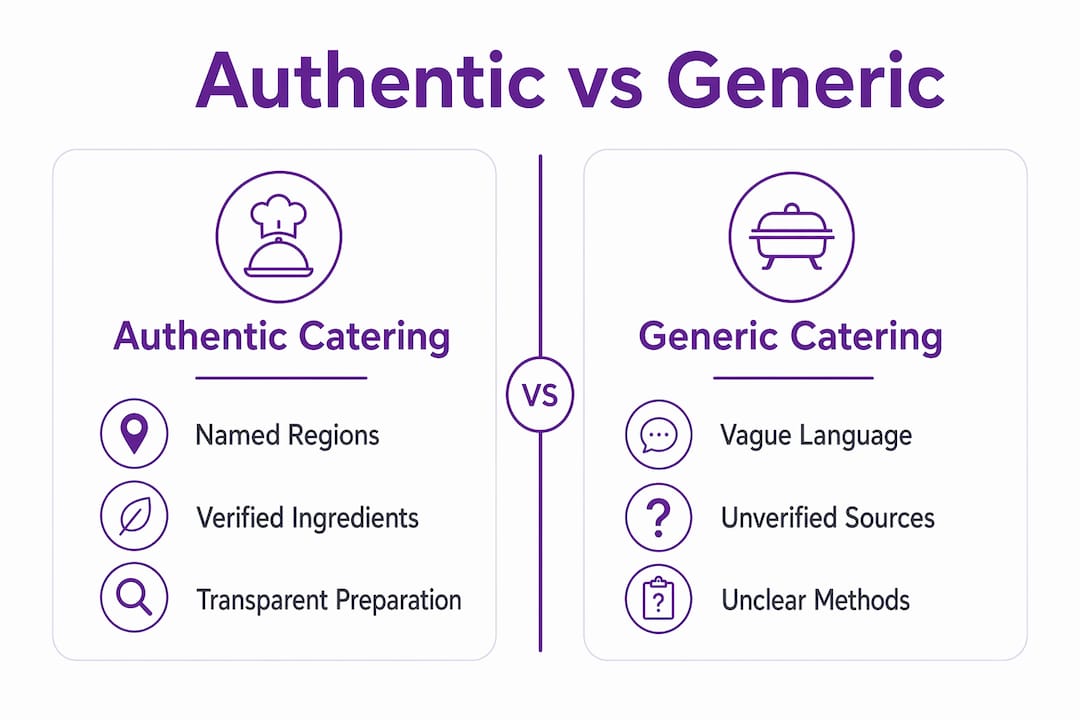
The contrast between authentic and generic catering experiences is measurable in guest satisfaction and repeat patronage. Research on culinary tourism authenticity shows strong positive correlations between authenticity expectations and satisfaction across emotional, learning, meaningful, and enjoyment dimensions. Guests who experience genuine culinary provenance do not just enjoy the meal. They remember it, talk about it, and return for it.
| Dimension | Authentic catering | Generic or vague catering |
|---|---|---|
| Menu language | Named regions, producers, and techniques | Broad labels like “modern” or “fusion” |
| Ingredient sourcing | Verifiable, named suppliers | Unspecified or interchangeable sources |
| Cultural grounding | Specific culinary tradition or heritage | Loosely themed or trend-driven |
| Guest trust response | High, based on verifiable specificity | Low, due to information gaps |
| Loyalty outcome | Strong repeat patronage | Transactional, low retention |
The heritage cuisine movement illustrates this contrast clearly. Customers increasingly prefer precise accounts like “Oaxacan mole” over “modern Mexican” labels, according to 2026 food trend analysis. This preference is not nostalgia. It reflects a rational trust calculation. A guest who reads “Oaxacan mole” knows the caterer has specific knowledge. A guest who reads “modern Mexican” has no way to evaluate the claim.
Authentic quality experiences also reinforce brand loyalty through a dual pathway: they increase both brand trust and perceived brand value simultaneously. For event organisers, this means that choosing an authentic caterer is not just a culinary decision. It is a reputational one. The food served at a corporate event or wedding reflects on the organiser’s judgement and care. Authenticity signals that the organiser chose substance over surface.
How can caterers practically integrate authenticity into menus and service?
Implementing authenticity in catering requires alignment across three operational areas: menu design, staff communication, and service delivery. Inconsistency between these areas undermines consumer trust and perceived authenticity, creating credibility gaps that erode the loyalty pathway. The following steps address each area directly.
-
Audit your menu language against your actual ingredients. Every descriptor on your menu must match what is in the kitchen. If your menu says “house-made salsa,” your salsa must be made in-house, not sourced from a commercial supplier. Burritosplendido presses tortillas daily from 100% Manitoba-produced flour. That claim appears on their menu because it is operationally true every single day.
-
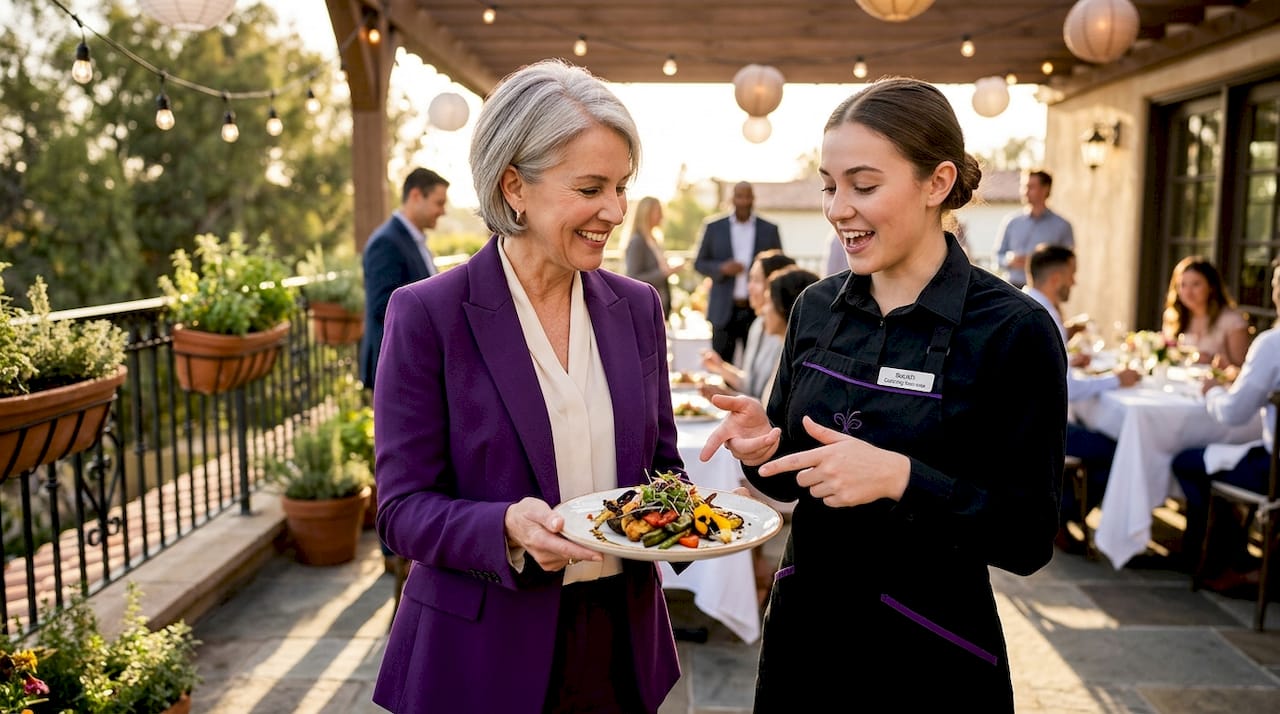
Train staff to explain provenance confidently. Front-of-house staff are the final link in the authenticity chain. A guest who asks “where does your chicken come from?” deserves a specific answer, not a shrug. Staff training should include the name of the supplier, the reason the caterer chose that supplier, and one or two facts about the product that reinforce quality. Burritosplendido’s team can speak to Granny’s Chicken by name, which turns a routine question into a trust-building moment.
-
Use storytelling in your event communications. Menus, signage, and pre-event briefings are all opportunities to communicate culinary provenance. A card at a catering station that reads “Barbacoa: shredded beef slow-cooked for eight hours using a traditional Mexican braising method” does more trust-building work than a plain label.
-
Align your sourcing with your cultural claims. If you are serving authentic Mexican cuisine, your ingredients and techniques should reflect genuine Mexican culinary knowledge, not a generic approximation. This alignment is what separates credible cultural catering from themed food service.
-
Review and update your authenticity dossier seasonally. Suppliers change, ingredients shift with seasons, and preparation methods evolve. A dossier that is six months out of date creates the same credibility gap as no dossier at all.
Pro Tip: Ask your kitchen team to explain each dish in one sentence without using the word “authentic.” If they cannot, the dish lacks the specific identity that guests and event organisers are paying for.
Key takeaways
Authenticity in catering builds consumer trust, and trust is the direct driver of loyalty. Caterers who treat authenticity as an operational standard rather than a marketing claim earn measurably stronger guest retention.
| Point | Details |
|---|---|
| Trust mediates loyalty | Authenticity drives loyalty only through trust, not directly. Build trust first. |
| Specificity signals credibility | Name ingredients, regions, and techniques. Vague labels do not build trust. |
| Consistency is non-negotiable | Menu language, kitchen practice, and staff communication must align at all times. |
| Authentic experiences are memorable | Guests who experience genuine culinary provenance return and recommend. |
| Storytelling reinforces authenticity | Provenance narratives at service points convert curiosity into trust. |
Why authenticity in catering is harder than it looks
I have spent years watching caterers claim authenticity and then underdeliver in ways that are entirely avoidable. The most common failure is not dishonesty. It is inconsistency. A caterer will source excellent ingredients for a client tasting, then substitute cheaper alternatives for the actual event. Guests notice. Not always consciously, but the food tastes different, the story does not hold, and the trust that was built during the tasting quietly evaporates.
The second failure I see regularly is what I call the vocabulary gap. A caterer will write “heritage Carnitas” on a menu because it sounds credible, but the kitchen team cannot explain what heritage means in that context, where the pork came from, or how the braising process differs from a standard slow-cook. When a curious guest asks, the answer is vague. That vagueness is a trust withdrawal, even if the food itself is genuinely good.
What I find genuinely encouraging is that the caterers who get this right are not necessarily the largest or most expensive operations. Burritosplendido is a fast-casual chain in Manitoba, and yet their sourcing specificity, from Bothwell Cheese to Peak of the Market produce, gives them a credibility story that many higher-priced caterers cannot match. The event catering guide they publish reflects the same transparency. Authenticity at that level is a choice, not a budget item.
The trend toward heritage cuisine and cultural specificity in 2026 is not a passing moment. Consumers are becoming more food-literate, and their tolerance for vague culinary claims is shrinking. Caterers who build genuine authenticity into their operations now are positioning themselves for the kind of long-term loyalty that no marketing budget can manufacture.
— Austin
Authentic catering from Burritosplendido: taste the difference
Burritosplendido brings the same commitment to genuine ingredients and transparent preparation to every catering event it serves. From Carnitas slow-braised in-house to tortillas pressed fresh daily from Manitoba flour, every item on the catering menu reflects a verifiable sourcing story. Event organisers across Winnipeg and Brandon trust Burritosplendido because the food delivers exactly what the menu promises, every time.
If you are planning a corporate event, wedding, or community gathering and want a catering experience that guests will remember and talk about, explore Burritosplendido’s catering services to see how authentic Mexican-inspired food can make your event stand out. For those wanting to understand the culinary philosophy behind the menu, the authentic Mexican food guide explains exactly what sets genuine preparation apart from generic alternatives.
FAQ
What does authenticity mean in a catering context?
Authenticity in catering means delivering food experiences grounded in verifiable ingredients, genuine preparation methods, and honest cultural representation. It is defined by specificity, such as named suppliers, regional origins, and traditional techniques, rather than broad marketing labels.
Why does authenticity matter for catering loyalty?
Research shows that authenticity builds trust, and trust is the direct driver of loyalty in food contexts. Authenticity does not produce loyalty on its own. It produces trust, which then converts into repeat patronage and referrals.
How can event organisers evaluate a caterer’s authenticity?
Ask the caterer to name their ingredient suppliers, describe their preparation methods, and explain the cultural origin of key dishes. A caterer with genuine authenticity can answer these questions specifically and consistently, without hesitation.
What is the biggest risk of claiming authenticity without delivering it?
Credibility gaps occur when menu language, kitchen practice, and staff communication do not align. These gaps erode trust rapidly, and inconsistency undermines perceived authenticity in ways that are difficult to recover from once a guest has noticed the discrepancy.
How does local ingredient sourcing support catering authenticity?
Using named local suppliers, such as Bothwell Cheese or Granny’s Chicken, gives caterers verifiable provenance claims that guests can evaluate and trust. Local sourcing also aligns with cultural preservation and responsible food practices, which strengthens the broader authenticity narrative.