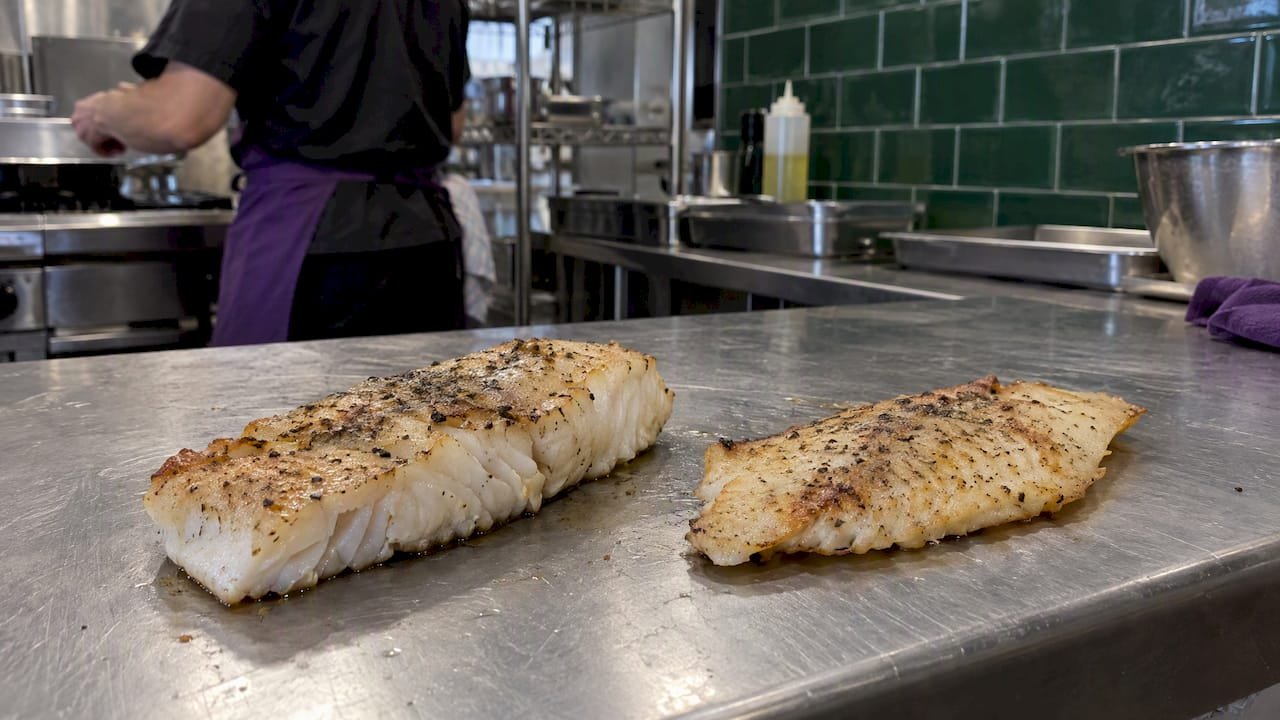
In Canada, “whitefish” usually means a cold-water freshwater fish from the Great Lakes and the Prairies, most often lake whitefish. Tilapia is a warm-water fish, mostly farmed, with mild white flesh. Both are lean, mild and flaky, and in a blind taste test they score close. The real differences are where they come from, how much fat they carry, how firm they cook and what you pay in effort to find them fresh. This guide walks through each, so you can pick the right fillet for the pan, the grill or a taco.
TL;DR
- Different fish, similar mildness. Whitefish is a cold-water freshwater fish of the salmon family. Tilapia is a warm-water farmed fish of the cichlid family.
- Taste and texture: a sensory study found Great Lakes whitefish and tilapia rated alike for flavour and overall acceptability. Whitefish is typically a little fattier and more delicate.
- Nutrition: both are good protein sources. Lake whitefish is also listed among species with lower mercury levels.
- Best use: tilapia for budget, thin fillets and fast pan cooking. Whitefish for baking, grilling gently and tacos where you want a richer flake.
- Read the label: the name, the place of business and the source tell you more than the word “white”.
Table of Contents
- What the names actually mean
- Taste and texture side by side
- Nutrition: protein, fat and calories
- Mercury, contaminants and what to watch
- Where each one comes from, and why it matters
- How to buy it: labels and freshness
- Cooking: which fish suits which method
- Which one should you choose?
- Our perspective: why Manitoba whitefish belongs in a taco
- Try it without cooking it
- FAQ
- Sources
What the names actually mean
Part of the confusion is that “white fish” can mean two things. One is a culinary category: any lean, pale, mild-flavoured fillet. The other is a specific group of species. Tilapia belongs to the first. Whitefish, as one word, belongs to both.
Whitefish: a family of cold-water fish
Whitefish is the common name for several freshwater fishes in the salmon family, subfamily Coregoninae, and 20 species are found in Canada. The one you will most often meet on a menu or at a fish counter is lake whitefish. Fisheries and Oceans Canada describes it as one of Canada’s most valuable fish species, living in cool, deep lakes and large rivers across most of the country. The department’s recommended trade name is “lake whitefish”, so that is the phrase to look for on a package.
For anyone in Manitoba, this is a local fish. Lake Winnipeg and the province’s northern lakes are home territory for it, which is why it shows up in regional cooking.
Tilapia: a warm-water cichlid
Ontario’s species profile identifies tilapia as a freshwater fish in the Cichlidae family, native to Africa and the Middle East. The Canadian Aquaculture Industry Alliance describes it as a warm-water fish with white, moist, mild-flavoured flesh. So when someone asks “is tilapia a white fish?”, the answer is yes in the culinary sense: pale, lean, mild. It is not a whitefish in the biological sense, and the two are not relatives.
Taste and texture side by side
If you expect a dramatic gap, the research disappoints. A Michigan State University comparison found that Great Lakes whitefish and tilapia received similar ratings for cooked appearance, flavour and overall acceptability, and whitefish scored the same as tilapia on cooked texture. In other words, a panel of tasters did not find one clearly better.
Outside the lab, the differences you notice at home come from fat, thickness and freshness.
| Lake whitefish | Tilapia | |
|---|---|---|
| Water | Cold, deep freshwater lakes and rivers | Warm freshwater, mostly farmed |
| Family | Salmonidae (Coregoninae) | Cichlidae |
| Flavour | Mild, a touch sweeter and richer | Mild, neutral |
| Texture | Delicate, fine flake | Lean, light flake, a little firmer in thin fillets |
| Typical fillet | Thicker, with skin | Thin, often skinless |
| Forgiveness | Dries out if overcooked | Dries out faster because it is thin |
The Globe and Mail reported that Ontario lake fish, especially whitefish, is delicate-fleshed and fattier and firmer when it comes out of icy water. That matches what cooks say: a cold-season whitefish fillet is richer and holds together nicely.
The “muddy” tilapia reputation
Tilapia has a reputation for tasting of mud. CBC Radio’s reporting on the fish notes it is called a white fish with a mild taste, while wild fish from highly eutrophic ponds could taste musty because of bacteria and algae. That is a growing-conditions issue, not a flaw in the species. A fresh fillet from a well-run farm should smell clean, which brings us to buying.
Nutrition: protein, fat and calories
Both fish are lean, high-protein options. The numbers below come from two different sources that use different portion sizes, so treat them as a rough comparison, not a laboratory head-to-head.
| Fish | Portion and method | Protein | Fat | Calories |
|---|---|---|---|---|
| Lake whitefish (native) | 75 g, baked, Health Canada | 17 g | 3 g | 100 kcal |
| Tilapia | 100 g, cooked, Metro | 26 g | under 3 g | not listed |
Scale the whitefish figures to 100 g and you get roughly 23 g of protein and 4 g of fat. That is our own arithmetic, and the two data sets were measured differently, so do not read it as proof that tilapia has more protein. The safe takeaway: both are lean, both deliver a solid dose of protein for a modest number of calories, and whitefish carries a bit more fat, which is why it tastes richer and cooks more gently.
For athletes and anyone tracking macros, the cooking method matters more than the species. A grilled or baked fillet in a corn tortilla is a very different meal from a battered, deep-fried one. We go through that in detail in our guide to high-protein tacos for athletes and in 200 calorie fish tacos.

Mercury, contaminants and what to watch
When readers search for this comparison, safety is often the quiet question behind it. Here is what the official pages say.
- Mercury in whitefish: Health Canada’s risk assessment notes that lake whitefish is listed by the Canadian Food Inspection Agency among species with lower total mercury, averaging less than 0.2 ppm.
- Inland fish in general: the Ontario government’s fish guide says panfish or whitefish from inland locations tend to have lower contaminants than top predatory fish.
- Fat and PCBs: the same guide advises that contaminants such as PCBs and pesticides concentrate in fatty fish, and that you can reduce exposure by trimming fat and cooking on a rack so fat drips away.
If you are pregnant, feeding young children or have a medical condition that limits fish intake, ask your doctor or a registered dietitian how often to eat fish and which kinds. For wild-caught fish from a specific lake, check the local advisory for that water body before you cook it. The advice above is general and does not replace it.
We found no Canadian official page that publishes a mercury figure for tilapia, so we will not put a number on it.
Where each one comes from, and why it matters
Whitefish on a Canadian counter is usually wild-caught from a lake fishery. Tilapia is almost always farmed. Fisheries and Oceans Canada lists tilapia among finfish farmed in British Columbia, Alberta and Ontario, so Canadian-raised tilapia exists, though much of what is sold in stores is imported. Check the package rather than assuming.
On sustainability, the Fisheries Council of Canada’s consumer guide says that 94% of Canadian fish stocks are harvested at sustainable levels, and that third-party sustainability certification gives shoppers the highest assurance of responsible harvesting. Look for a certification mark if it matters to you, on either fish.
The broader question of why a short supply chain changes freshness, and what it costs, is covered in this piece on local sourcing benefits and challenges. It applies to fish as much as to vegetables: fewer days between the water and your plate usually means a cleaner flavour.
How to buy it: labels and freshness
A few checks work at any counter.
- Read the name. Look for “lake whitefish” or the species name, not a vague “white fish” or “whitefish blend”.
- Find the responsible party. The CFIA says labels for prepackaged fish must include the name and principal place of business of the party responsible for the product. If it is missing on a package, ask the store.
- Smell it. Fresh fish should not smell strong. For tilapia, Metro’s guide says fresh flesh should be translucent white or ivory without a strong odour, and that the firm pink raw flesh turns a smooth milky colour when cooked.
- Press and look. Flesh should spring back, and fillets should look moist, not dried at the edges or sitting in liquid.
- Plan the day. Cook fresh fillets within a day or two, or freeze them. Thin tilapia fillets thaw quickly; thicker whitefish needs a night in the fridge.
Cooking: which fish suits which method
Health Canada’s guide lists grilling, baking, searing, roasting and poaching as popular ways to cook fish such as whitefish. Metro describes tilapia as highly versatile, suited to poaching, grilling, pan-frying, deep-frying, braising, roasting and steaming. Here is how that plays out in a home kitchen.
Whitefish
- Baking or roasting: the extra fat gives you a wider margin before the fillet dries out. A hot oven and a squeeze of lime is enough.
- Pan-searing, skin on: a thick, skin-on piece crisps nicely. Start skin side down and leave it alone.
- Gentle grilling: use a well-oiled grate or a fish basket. The delicate flesh breaks easily if you flip it too often.
- Tacos: the fine flake breaks into bite-size pieces that sit well in a warm tortilla.
Tilapia
- Pan-frying: thin fillets cook in a few minutes per side. Pat them dry first for a better colour.
- Steaming or poaching: a good fit for light dishes, since the mild flesh takes on herbs, citrus and spices.
- Baking with a sauce: a salsa or marinade does the heavy lifting, since the fish itself is neutral.
- Tacos: works well if you season it boldly and cut it into strips before cooking.
For either fish, use a thermometer rather than guesswork. Our walleye taco guide covers the 70°C target and three cooking methods, and the same approach applies to whitefish and tilapia.
Which one should you choose?
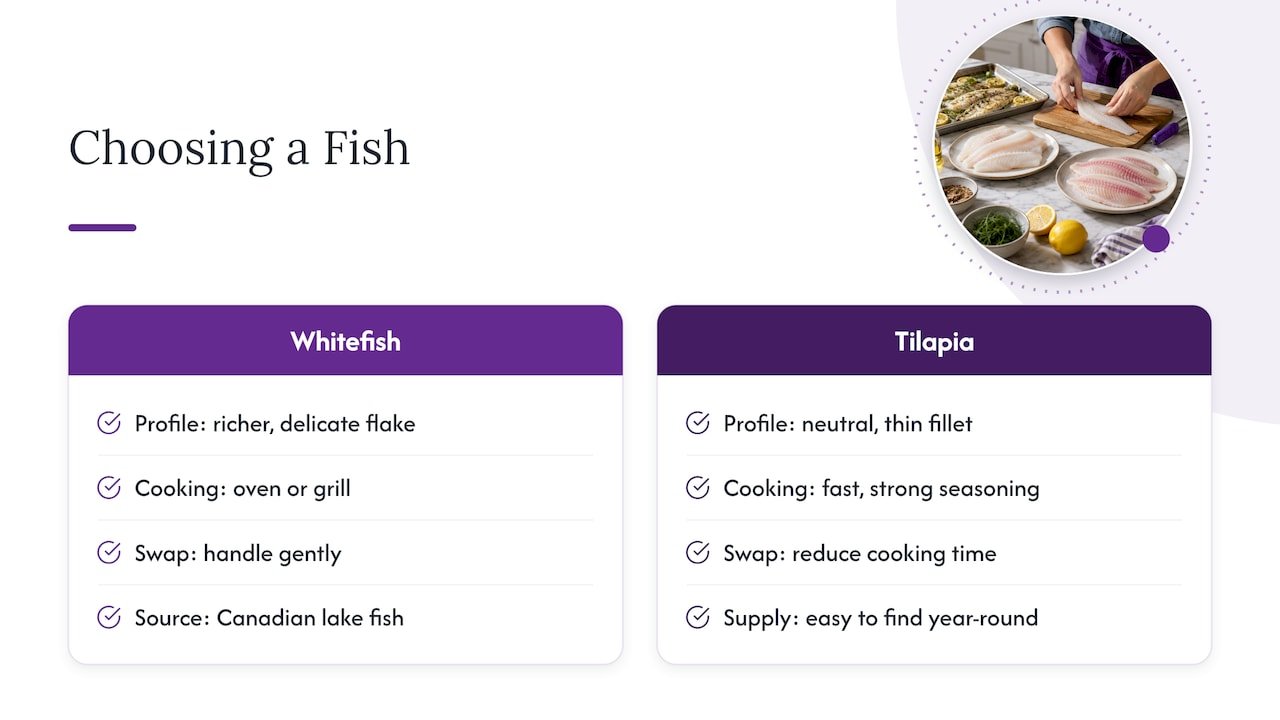
Pick whitefish if you want a richer, more delicate flake, you cook in the oven or on the grill, or you care about eating regional fish from Canadian lakes. Pick tilapia if you want a neutral, thin fillet that cooks fast, takes on strong seasoning and is easy to find year-round. If a recipe calls for one, you can usually swap in the other: adjust the cooking time down for thin tilapia and handle whitefish a little more gently.
For tacos specifically, whitefish is our preference, and we explain why in what is a Manitoba whitefish taco. To build the rest of the plate, use our 12-step taco assembly guide and the checklist for authentic tacos.
Our perspective: why Manitoba whitefish belongs in a taco
We run a from-scratch kitchen in Winnipeg, and our approach starts with a simple rule: use what is grown, raised and caught nearby when we can. That is why our seasonal specialties include tacos made with Manitoba whitefish or pickerel. Tortillas are pressed with 100% Manitoba flour, proteins like carnitas and barbacoa are slow-cooked and hand-pulled in-house, and we run a deep-fryer-free kitchen. For fish, that means grilled or pan-cooked fillets, not battered ones.
We do not think tilapia is a bad fish. It is a practical, mild and lean fillet, and plenty of home cooks use it well. But when a fish from our own lakes is on offer, it has what a taco needs: a delicate flake that takes lime, cabbage and a bright salsa without disappearing. If you cook at home, the best advice we can give is to buy the freshest fillet you can find, season it simply, cook it just until it turns opaque and flakes, and put the effort into the tortilla and the toppings.
If you manage a dietary need such as gluten-free, vegan or keto, ask our team how a dish is prepared. Our staff are trained to handle cross-contamination questions.
— Austin
Try it without cooking it
If you would rather let us do the work, our menu includes tacos, bowls, burritos, quesadillas and salads, all made fresh daily in Winnipeg, and you can order online for takeout or delivery. Planning a lunch for the office or an event? Our catering page lists Burrito Express at $1,050 to $1,150, Burrito Express Deluxe at $1,550, a $20 delivery and set-up fee, $15 per hour per staff member for catering staff and 10% gratuity. Seasonal fish specials vary, so check the menu for what is on now.
FAQ
Is tilapia a white fish?
Yes, in the culinary sense. It has pale, lean, mild flesh, and the Canadian Aquaculture Industry Alliance describes its flesh as white, moist and mild-flavoured. It is not a whitefish in the species sense, which refers to the salmon-family fish found in Canadian lakes.
Is whitefish healthier than tilapia?
Neither wins outright. Both are lean, protein-rich fish, and whitefish carries slightly more fat. Lake whitefish is also listed among species with lower mercury levels. Your cooking method matters more: baking or grilling beats deep-frying for either fish.
Can I substitute tilapia for whitefish in a recipe?
Usually, yes. The flavours are both mild, and the taste test results were close. Reduce the cooking time for thin tilapia fillets, and handle whitefish gently because its flesh is more delicate. Check with a thermometer so neither fish dries out.
Which fish is better for tacos?
We prefer whitefish for its richer, flaky texture, especially Manitoba-caught. Tilapia works if you season it boldly and cut it into strips. Either way, grill or pan-cook it instead of frying, and finish with fresh toppings.
Sources
- Whitefish in Canada, The Canadian Encyclopedia
- Lake Whitefish, Fisheries and Oceans Canada
- TERMIUM Plus, Coregonus clupeaformis
- Tilapia species profile, Ontario
- Canadian Farmed Tilapia, Canadian Aquaculture Industry Alliance
- Great Lakes Whitefish: How does it compare to other popular fish species
- From muddy-tasting to seafood staple, CBC Radio
- Ontario fish is fattier and firmer in icy waters, The Globe and Mail
- Nutrient Value of Some Common Foods, Health Canada
- All About Tilapia, Metro
- Human Health Risk Assessment of Mercury in Fish, Health Canada
- Guide to Eating Ontario Fish
- Aquaculture Sector Snapshot, Fisheries and Oceans Canada
- Seafood consumer guide, Fisheries Council of Canada
- Labelling requirements for fish and fish products, CFIA
- A simple guide to selecting fish, Health Canada
- What is local sourcing: benefits, challenges and impact